1. Introduction
Computational power systems have become increasingly important in industry, research, and education due to the rapid advancement of smart grid technologies. To meet the growing demand for engineers capable of contributing to grid modernization, we developed a course focused on computer-based power-system analysis.
The course presented in this study originated at the University of Pittsburgh, a research-intensive institution, as Power Systems Analysis 2, a follow-up to Power Systems Analysis 1. These courses are primarily designed for upper level undergraduate students or graduate students. Prior experience in programming is helpful but not required. The first course introduces fundamental topics, including three-phase circuit analysis, per-unit modeling, transformers, transmission lines, reactive power compensation, and a basic overview of power flow methods. The second course builds on this foundation with more advanced topics, including power flow using the full Newton-Raphson algorithm, the fast-decoupled Newton-Raphson algorithm, and the dc power flow algorithm. It also covers symmetrical and asymmetrical fault studies.
Initially, students in Power Systems Analysis 2 used the commercial simulator PowerWorld, generously provided in an educational version by PowerWorld Corporation (PowerWorld Corporation, 2025), alongside the textbook Power System Analysis and Design by Glover, Sarma, Overbye, and Birchfield (Glover et al., 2022). One recurring challenge was that students often lacked intuition about the simulator’s internal workings, resulting in preventable errors.
To address this, we created a modified version of the course titled Advanced Power Systems Analysis. This version shifted toward using MATLAB to implement small-scale simulations on systems with three or four buses (nodes). Students developed basic programs for poTwer flow and fault analysis. This hands-on approach significantly improved their understanding of the underlying algorithms and of how tools such as PowerWorld function.
As programming proficiency has increased due to both curricular enhancements and greater exposure in high school, we proposed a third iteration of the course in 2023. This updated version, recently renamed Computer Analysis of Power Systems, initially adopted a partial project-based learning (PjBL) approach. Students spent approximately four weeks in a traditional lecture format, after which the remainder of the course focused on developing a full-scale power systems simulator in Python capable of performing power flow and fault studies. Based on the success of this structure, the course transitioned to a fully PjBL format in 2024 and 2025. PowerWorld remains part of the course, but is now primarily used to validate student-developed simulators.
Beginning in the 2025 offering, students were also encouraged to leverage generative AI (genAI) tools such as ChatGPT (OpenAI, 2024) for assistance with software development, debugging, and theoretical exploration. In addition, the 2025 offering incorporated two new assessment components: a three-week introductory simulation assignment in which students developed a basic dc circuit simulator, and a three-week individual final project requiring students to implement a self-selected enhancement to their power systems simulator. The inclusion of these additional assessments was made feasible by students’ ability to progress more efficiently through earlier milestones with support from genAI tools.
In this paper, we present an instructional approach that integrates PjBL, software development, and genAI into a power systems analysis course. The approach is designed to deepen student understanding by requiring them to develop simulation tools, validate results using commercial software, and leverage genAI to support the resolution of technical challenges.
PjBL has been established for over two decades as an active-learning approach that emphasizes extended, independent projects to enhance student engagement. Unlike traditional lecture-based models, PjBL centers class time around project work with individualized instructor guidance. A meta-analysis of 66 quasi-experimental studies found that PjBL significantly improves student learning outcomes compared to traditional instructional methods (Zhang & Ma, 2023). However, the literature examining the combined use of PjBL and genAI remains limited. Given the individualized and iterative problem-solving nature of PjBL, genAI has the potential to serve as a supplementary support tool by providing on-demand feedback and guidance. This study examines whether integrating genAI can further enhance the educational benefits of PjBL in the context of power systems analysis.
2. Background and Related Work
2.1. Computer Methods in Power Systems
Computer modeling has been central to electric power systems analysis since the 1970s, providing the foundation for modern tools used in planning and operations (Kersting & Kerestes, 2022). Simulators such as PowerWorld are widely used in education and industry for steady-state power-flow and fault analysis, and the textbook (Glover et al., 2022) includes a student-accessible version. However, these tools often obscure the underlying computations, limiting student intuition.
MATLAB and Simulink are widely used software products familiar to many engineering students and are employed as educational tools to demonstrate the underlying equations of power system components. The authors of (Ayasun & Nwankpa, 2006) and (Ayasun & Nwankpa, 2005) developed Simulink models of transformers and induction motors, respectively, and had students run simulations on these models, documenting output parameters, including voltage, current, real power, and reactive power, under various configurations. The simulation models are provided to students in their complete form, followed by assignments requiring students to program their own versions of the models under different conditions. The students then conduct tests on physical equivalents of the simulation models. In (Ayasun & Nwankpa, 2006), the authors found that 70% of students reported that the simulations helped them understand the physical experiment conducted later in the course, and 45% reported that the simulations helped them deepen their understanding of transformer theory.
Beyond modifying existing program files or developing similar models based on the original program, programming projects offer a path to a deeper understanding of modeling problems. By writing code to solve analytical problems, students engage directly with the algorithms used by commercial simulators (Milano, 2014). In prior work, instructors developed a course in which students build a power systems simulator from scratch, demonstrating the pedagogical benefits of this hands-on approach (Radatz & Kerestes, 2023). Python has become a dominant language for power systems analysis, supported by tools such as Pandapower (pandapower, 2024) and OpenDSS (EPRI, 2019). Furthermore, researchers in (Fernandes et al., 2018) demonstrate that the Python programming language, combined with common libraries like NumPy and matplotlib, offers a robust environment for demonstrating core concepts of power systems analysis, including formation of the bus admittance matrix, power system state estimation (PSSE), and fault studies. Python’s extensive collection of mathematical and visualization libraries, as well as its integration with other power systems analysis platforms to enable scripting, automation, and customized analyses, makes Python a natural fit for instructional use.
This work builds upon those foundations by integrating object-oriented Python programming, PjBL, and genAI into a redesigned power systems course to enhance both student engagement and technical proficiency.
2.2. Generative AI
Since their release in late 2022, genAI tools such as ChatGPT have rapidly gained attention in educational research and practice. McDonald et al. (McDonald et al., 2025) conducted a comprehensive review of institutional responses across 116 R1 universities in the United States, finding that genAI use was explicitly encouraged at 63% of sampled institutions. Economides and Perifanou (Economides & Perifanou, 2024) conducted a study in an e-commerce course showing that frequent and strategic use of genAI strongly correlated with higher project and course performance. Furthermore, those who avoided it generally performed poorly. Bilgin et al. (Bilgin et al., 2025) found that, in core chemical engineering courses, faculty reflections highlighted the usefulness of genAI in the initial stages of course development, including syllabi, learning objectives, and simple assessments. Das et al. (Das et al., 2025) found that incorporating AI-generated problems in conjunction with traditional textbook problems improves students’ application skills and overall performance. Sun and Zhou (Sun & Zhou, 2024) conducted a meta-analysis that showed that genAI had a moderate effect on students’ academic achievement and suggested that genAI can be adapted to the needs of different learning activities. Furthermore, Su and Yang (Su & Yang, 2023) echoed this adaptability of genAI, identifying personalized learning support for students and improved support for teachers in answering student questions as key benefits. Qadir (Qadir, 2023) examined the potential use cases of genAI in engineering education, including language editing, virtual tutoring, question generation and solving, and research assistance. Wood and Moss (Wood & Moss, 2024) found that incorporating genAI in a master’s instructional design course increased students’ comfort level and understanding of the proper uses of the technology. Dai (Y. Dai, 2025) found that, in addition to ideation, walkthroughs, and feedback, students used genAI as a mediator between student and instructor interactions and to overcome gaps in non-technical expertise. Alkinani (Alkinani, 2025) demonstrated that, through the implementation of genAI and computational intelligence in two programming courses, assignment scores improved by 10% and task completion time decreased by 25-30%. It is also important to note that ethical considerations and concerns regarding the use of genAI in the classroom were highlighted in many of the articles cited above. We ensure that genAI is used ethically through clear guidelines for use and instruction on optimal use cases.
2.3. Project-Based Learning
Active learning strategies have consistently been shown to enhance teaching effectiveness and improve student learning outcomes (Prince, 2004). Among these, Project-Based Learning (PjBL) stands out as a particularly effective approach, fostering student motivation, supporting autonomy, and promoting higher-order cognitive skills such as elaboration, critical thinking, and metacognitive self-regulation (Stefanou et al., 2013). Regarding specific implementation instances, Peng et al. (Peng et al., 2017) designed a web-based PjBL system for programming with computer-based scaffolding, reporting positive reception and higher motivation to learn programming through the system. Maheswaran et al. (Maheswaran et al., 2022) utilized PjBL in the context of a piezoelectric energy wheel, noting that aspects of PjBL, such as research, design, and trial-and-error, were invaluable skills gained by the students through the project. Jahan et al. (Jahan et al., 2018) used algae as a basis for a research project, where students had to choose a country and determine how algae could benefit the future of their country. The project received positive reviews from students and forged a link between STEM and the humanities that would have been difficult to achieve through traditional learning approaches. Khambuo et al. (Khambuo et al., 2024) studied the effect of PjBL in a high school chemistry classroom, finding that a constructionist PjBL approach improved students’ learning achievement at the 0.05 significance level, citing the generation of self-knowledge and improved critical thinking skills. Wang et al. (Wang et al., 2014) implemented a PjBL approach for secondary school students in computer programming education and reported significant improvements in understanding following the learning activity. Evenddy et al. (Evenddy et al., 2023) conducted a review of the benefits and challenges of PjBL in higher education, reporting multiple benefits, including enhanced student engagement, collaboration, and problem-solving. Dureh (Dureh, 2021) administered a questionnaire among first-year students in an “Answering questions with data” PjBL course, determining that students’ growth score before the class was significantly different than the growth score after the class. Furthermore, there was an open-ended portion of the questionnaire, where students indicated the benefits of PjBL, such as promoting relationships and teamwork. Krishnan and Nalim (Krishnan & Nalim, 2009) describe a PjBL approach implemented in an introductory thermodynamics course, finding PjBL resulted in benefits such as “keeping student motivation alive”, integrating course topics before they are presented in a lecture component, providing multiple avenues for feedback between them, the instructor, and other peers, and inspiring the students.
The authors in (Hosseinzadeh & Hesamzadeh, 2012) specifically utilize PjBL in a power systems engineering course. The authors describe their approach as aligning with the “pure” PjBL/PBL course design described in (Mitchell et al., 2010), in which there are no planned lectures throughout the course. Their specific power systems engineering course is one of several PjBL courses integrated into their university’s electrical engineering curriculum, following other first-year PjBL courses. The course spreads course topics across four projects, each of which students work on in teams. These projects differ from those presented in this paper in that they primarily involve applying standard power industry software tools to engineering problems. A key goal of our study’s course, as discussed in Section 2.1, is to expose students directly to the underlying computations of these software tools. As such, the projects developed for this course heavily emphasize programming rather than use of any existing software platform.
2.4. Coupling Project-Based Learning and Generative AI
Our study combines genAI with PjBL to provide an additional layer of support for students, with the aim of further enhancing their final course product. Currently, limited literature exists on the topic. Wu and Chang (Wu & Chang, 2023) applied genAI to a PjBL framework in higher education, with three assessment domains designed to enhance ethical use and promote innovative problem solving. Aref (Aref, 2024) employed genAI in a team-building framework within the context of PjBL, creating a novel GPT known as “The Project Pal” that is tailored to assist students with their project assignments and promote ethical AI use. Kusam et al. (Kusam et al., 2024) used a fine-tuned ChatGPT model in a project-based CS course to provide effective feedback to students, confirming that the specialized model improved the quality of feedback compared with the base ChatGPT model. Starling and Tian (Starling & Tian, 2024) employed genAI in the design process for first-year engineering students, including knowledge acquisition and code writing. Positive reviews were received from students, as it saved them time when assessing technical skills for their projects. Saeliang and Chatwattana (Saeling & Chatwattana, 2024) experimented with developing a PjBL model to enhance the programming skills of vocational students using genAI; empirical results provided strong support for the development of the PjBL model using genAI. Dai et al. (W. Dai et al., 2024) conducted a year-long study on an online PjBL platform with a genAI plugin, highlighting that genAI complements the communication aspect of PjBL well and also stimulates deep learning and critical thinking. Gou and Ren (Gou & Ren, 2024) integrated a joint PjBL and genAI model into a Python programming course, demonstrating a significant increase in students’ computational thinking skills, particularly in algorithm design, assessment reflection, and task decomposition. Van Dijk and Zaytsev (Dijk & Zaytsev, 2025) conducted a pilot study in a first-semester object-oriented programming course, showing that students with access to genAI tools submitted generally higher-quality code and documentation. Li (Li, 2025) employed a genAI-driven PjBL model in a health Big Data course, demonstrating that the genAI-equipped framework had a significant increase in student engagement, critical thinking capacities, technical proficiency, and problem-solving capabilities. Furthermore, instructor workload decreased without a decline in educational quality. Finally, Osman et al. (Osman et al., 2025) investigated a genAI and PjBL environment in an educational technology and communication course through a quasi-experimental design, showing that students in the genAI-powered group exhibited stronger performance in systemic thinking.
2.5. Synthesis and Positioning of the Present Study
Overall, there has been extensive work done into project-based learning over the years, with comparably less work done into genAI due to it being a relatively recent innovation. However, there has been even less work done into the coupling of the two, especially in the context of power systems. While prior literature, such as Saeling and Chatwattana (Saeling & Chatwattana, 2024), used a project-based learning and genAI approach to improve the programming skills of students, our paper introduces a few new perspectives that have previously not been or have been minimally addressed. First, our paper specifically studies upper class undergraduate and graduate students as compared the several studies on first-year engineering courses. Since these students therefore have had at least a few more years of formal academic training, this allows us to use this combined PjBL-genAI approach to reach a higher level of Bloom’s Taxonomy through the creation of a simulator as compared to a foundational first-year course. Second, there have been minimal studies examining the intersection of PjBL and genAI in power systems analysis or electrical engineering in general. Our paper therefore illustrates an additional application area to which the coupling of PjBL and genAI is utilized.
3. Research Questions
This study investigates the educational impact of integrating PjBL with genAI tools in a computer analysis of power systems course. In this paper, we focus specifically on the following research questions:
-
Does the integration of PjBL and genAI improve learning outcomes, as measured by student progress and performance in the multi-milestone simulator project? (e.g., see (J. B. Biggs, 2003) on constructive alignment and assessment-driven learning)
-
Does the use of genAI tools enhance student motivation and persistence when tackling complex, open-ended engineering problems?
These questions were selected to align directly with the course redesign goals and assessment structure, which emphasize mastery of technical skills, iterative development, and sustained engagement over an extended project timeline. Learning outcomes are evaluated through milestone completion, simulator accuracy, technical documentation quality, and instructor-led oral explanations, while motivation and persistence are examined through student self-reports and observed project continuation behaviors.
Additional research questions related to accessibility for students with limited prior coding experience and the development of student confidence are important dimensions of this instructional approach but are beyond the scope of the present study. These questions will be examined in future offerings of the course as additional longitudinal and comparative data become available.
4. Methodology
4.1. Student Demographics
The population of interest comprises all students enrolled in a project-based advanced power systems course over time. To analyze the population, we use a sample of 21 students from the 2025 cohort and historical course data. Of this sample of 21 students, there is a split between undergraduate and graduate students and between ECE and non-ECE backgrounds. The exact breakdown of these attributes is summarized in Table 1.
4.2. Assessments and Analysis: Milestones, Pre-surveys, Student Course Evaluations
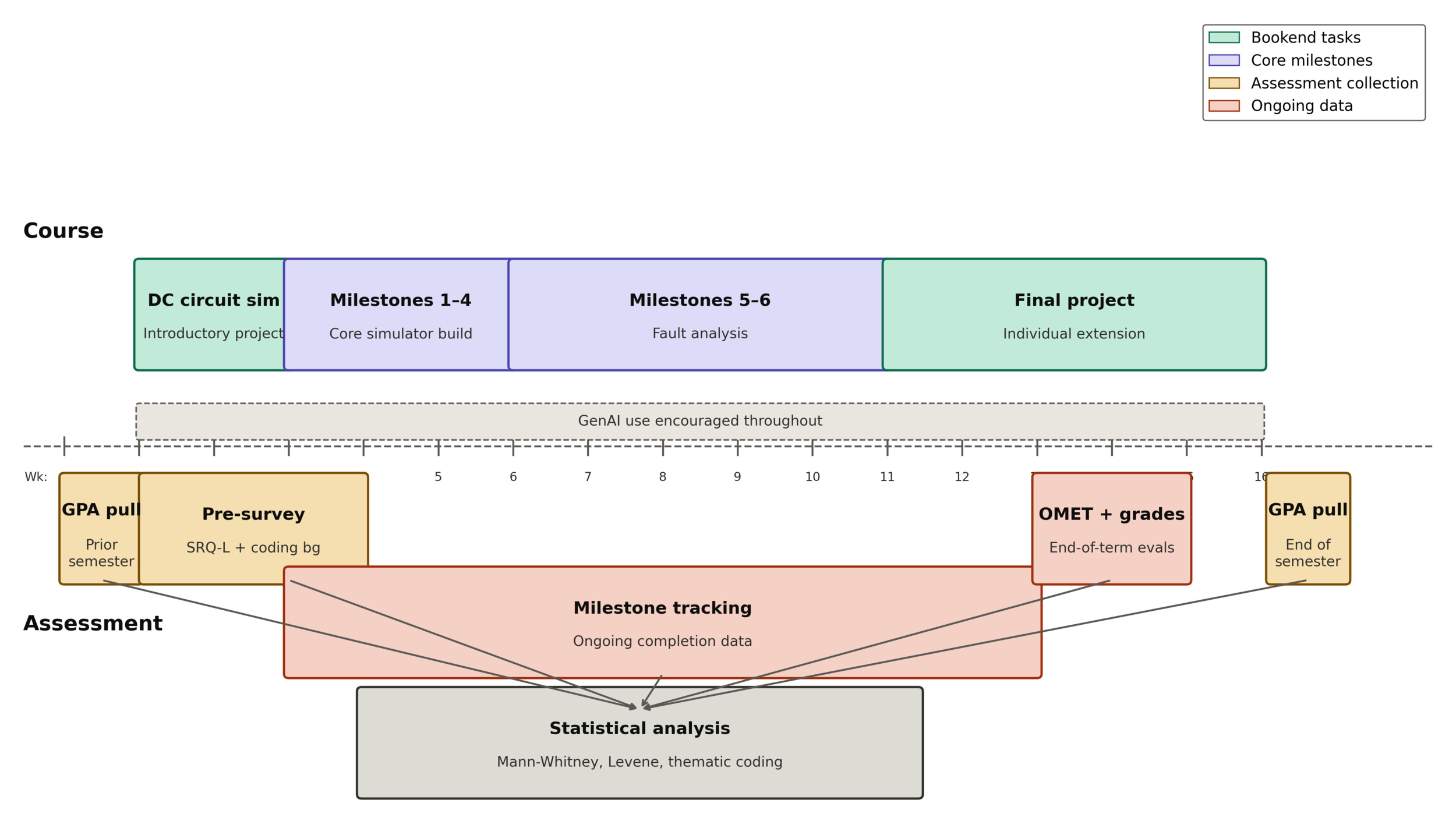
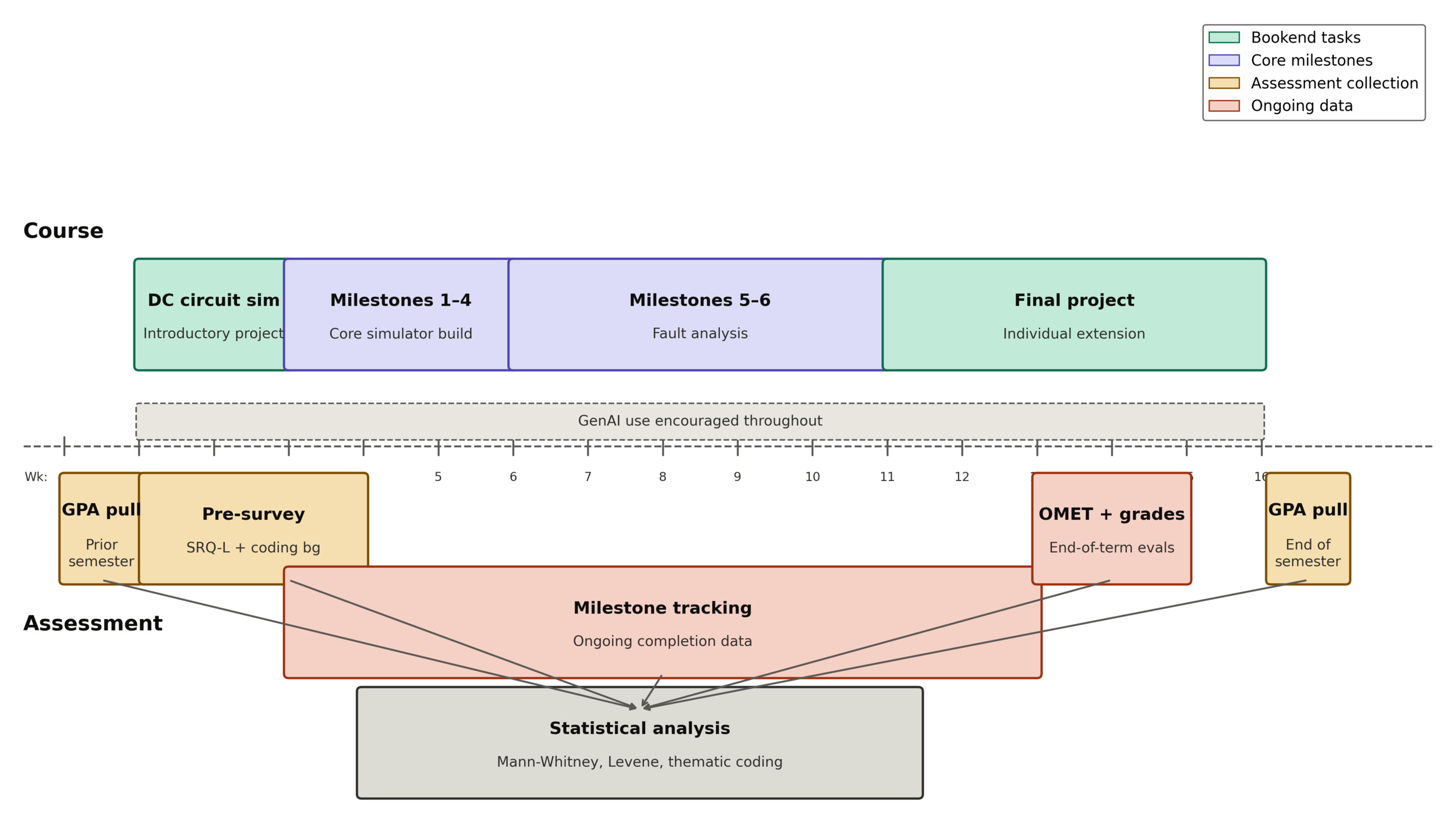
This section describes the assessment instruments and data sources used to evaluate the impact of the course redesign and the integration of genAI. Three complementary sources of evidence were analyzed: (i) milestone-based project performance data, used to assess student learning outcomes and technical proficiency; (ii) pre-course surveys measuring student motivation and prior programming experience; and (iii) end-of-term student course evaluations, used to examine student perceptions of instructional effectiveness. Together, these measures provide both objective and self-reported indicators aligned with the study’s research questions. Below, in Figure 1, we provide a diagram that demonstrates the assessment timeline for this course, both in terms of pedagogy and research.
4.2.1. Assessment Structure
The course was conducted over a 15-week semester with two 75-minute meetings per week and utilized a project-based learning framework in place of traditional examinations, quizzes, and homework assignments. Assessment consisted of three projects: (i) a three-week individual dc circuit simulator project (10% of the course grade), (ii) a team-based power systems simulator project organized around six milestones (60%), and (iii) a four-week individual simulator enhancement project (30%). The introductory project provided a foundation in Python programming, object-oriented design, and basic electrical engineering concepts. The milestone sequence then guided students through progressively more advanced power systems analysis algorithms, including network modeling, power flow analysis, and fault studies. Finally, students independently proposed, implemented, tested, and validated an original simulator enhancement, providing a transition from structured learning activities toward open-ended engineering design.
4.2.2. Student Guidance, Assessment, and Generative AI Integration
Students received guidance through milestone specification documents, video modules, in-class discussions, instructor consultations, and just-in-time lectures. Each milestone included implementation objectives, testing procedures, and validation requirements, often requiring comparison against textbook examples and the commercial simulator PowerWorld. Assessment emphasized demonstrated mastery rather than adherence to fixed deadlines. Although target completion dates were established, milestones were considered complete only after students demonstrated functional software and sufficient conceptual understanding during meetings with the instructional team. Evaluation incorporated software functionality, technical documentation, and structured oral examinations in which students explained the architecture, implementation, and mathematical foundations of their programs.
Beginning in 2025, students were encouraged, but not required, to use genAI tools such as ChatGPT to support software development, debugging, code interpretation, and exploration of theoretical concepts. GenAI was presented as a supplemental learning resource rather than a solution generator. Instructors provided just-in-time lectures throughout the semester that demonstrated effective strategies for using genAI to troubleshoot software, understand algorithms, interpret error messages, and support engineering problem solving. Students remained responsible for all submitted work and were required to explain and defend their implementations during oral examinations. This combination of structured milestone guidance, iterative instructor feedback, targeted instruction on AI-assisted problem solving, and oral assessment was intended to ensure that genAI served as a learning scaffold while preserving student ownership of the final software product.
4.2.3. Milestones
As mentioned, the Spring 2025 iteration of the course does not rely on traditional summative assessments such as exams, homework, or quizzes. Instead, over time, the course has shifted to a mastery-based assessment model focused on demonstrated technical skills. The course consists of six project milestones that students must complete. For each milestone, students are required to validate their program against the specified requirements using the PowerWorld software, achieving at least 99% accuracy for all measurable outcomes. In addition, students must orally explain their program to the instructor, demonstrating a clear understanding of its structure, logic, and operation. Finally, students must produce technical documentation that presents the underlying theory, governing equations, assumptions, and a description of how the software implementation functions. Milestones were used to compare cohort 2025 with cohorts 2023 and 2024. While the core six milestones remained consistent across offerings, the Spring 2025 cohort completed additional assessment components beyond these milestones, reflecting an expanded course scope enabled by increased student productivity.
Each project milestone requires both a functional software submission and accompanying technical documentation. Students are expected to provide a written explanation of their approach, including relevant equations, assumptions, results, and units, rather than relying solely on the computer program’s output. The assessment methods used in this course align with standards-based grading practices (Iamarino, 2014), in which students are evaluated on demonstrated mastery of clearly defined learning objectives rather than on point accumulation, as described in Table 2.
In addition to milestone and final project data, we first administered pre-course surveys on students’ motivation and prior coding experience. This was done via a Qualtrics form distributed on the course’s Canvas page. Then, at the conclusion of the course, final grades, teaching evaluations, and milestone completion data were collected. Milestone completion data and final grades were collected to assess the trajectory and final proficiency of students’ projects, and teaching evaluations were used to determine whether the instructor’s methodology was successful.
4.2.4. Pre-surveys
In the Spring of 2025, we added the Learning Self-Regulation Questionnaire (SRQ-L) (Black & Deci, 2000; Williams & Deci, 1996) and a computer programming background survey (Michigan State University, n.d.) to assess students’ initial motivation for learning in the course and their proficiency in computer programming and other relevant skills. The SRQ-L comprises 12 Likert-scaled questions (ranging from 1-“not at all true” to 7-“very true”) and is divided into three sections of four questions each: one assessing active participation, one assessing adherence to instructor advice, and one assessing the expansion of knowledge. The computer programming background survey comprises 19 questions: a combination of selected-response items for ease of analysis and constructed-response items that allow students to elaborate on their knowledge.
In 2025, the Motivation and Coding Background Survey, obtained online from Michigan State (Michigan State University, n.d.), was conducted three weeks after the start of the term. We asked participants to complete a survey that included demographic questions, related industry and coursework experience, and the 12-question Learning Self-Regulation Questionnaire (L-SRQ). This questionnaire provides students’ motivation for taking the course via a calculated Relative Autonomy Index (RAI). A high value reflects high autonomous motivation.
4.2.5. Teaching Evaluation Scores
To determine the impact of incorporating genAI into the course on students’ perceptions of teaching effectiveness, we evaluated the end-of-term student teaching evaluation score, “Overall evaluation of instructor effectiveness,” between the Spring 2024 and 2025 semesters. Details are provided in Table 5. The average score and standard deviation for the ECE department and the entire School of Engineering for the 2024 and 2025 academic years were also calculated for this metric. The student surveys also include three open-ended questions that we analyzed for quotations regarding the motivational use of genAI to support student learning. These questions are: What did the instructor do to help you learn?, What could the Instructor do to improve?, and Please provide advice to future students: What could you have done to improve your learning in this course? Quotes related to motivation were called out in Table 6.
4.3. Prior Semester and Current Semester Student GPAs
Statistical similarity between the student cohort GPAs for the Spring 2023, 2024, and 2025 semesters were assessed using the Kruskal-Wallis test for both the start of the semester and the end of the semester (Fall 2023, 2024, and 2025) in which the Computer Analysis of Power Systems class was held (Spring 2023, Spring 2024, and Spring 2025, respectively). The choice of a non-parametric test was necessary because the distribution of the dependent variable, GPA, did not meet the assumption of normality required for parametric testing. Specifically, academic dismissal thresholds and the 4.0 grading cap create a small distribution that is resistant to standard normalization.
4.4. Computer Analysis of Power Systems Course Grades
Student performance in the class was evaluated using a weighted point-based metric derived from the institution’s internal grading system. Rather than utilizing a standard 4.0 GPA conversion, final grades were calculated by multiplying the numerical grade point value of the earned letter grade (on a +/- scale) by the total number of course credit hours. This produced a continuous scale ranging from 0 to 12.0 for a 3-credit course, providing the necessary sensitivity to detect subtle variations in achievement within a high-performing cohort.
To assess differences in performance and consistency between the 2024 (n=10) and 2025 (n=21) cohorts, the data were first screened for normality and homogeneity of variance. Due to the presence of non-normal distributions and unequal variances, the Kruskal-Wallis test was selected as a non-parametric alternative to the independent samples t-test. This rank-based procedure is resistant to the influence of extreme values and accounts for the “ceiling effect” common in high-achievement data of the final course grades.
To evaluate changes in group consistency, Levene’s test for equality of variances was used. Variability was further quantified using the Interquartile Range (IQR) to ensure a representative assessment of dispersion that remains unaffected by outliers. All analyses were conducted using a two-tailed alpha level of .05.
4.5. Generative AI Disclosure
ChatGPT (OpenAI, version GPT-5) was used to refine the language in this document for concision and clarity. The authors verified all generated text for factual accuracy and ensured the final content reflects their own interpretations.
5. Results
5.1. Cohort Similarities between 2023, 2024, and 2025: Student GPA Analysis
A Kruskal-Wallis test was conducted to assess whether there were significant differences in student GPAs between the undergraduate and graduate cohorts for Spring 2023, 2024, and 2025 cohorts. Results indicate that GPA distributions were statistically similar between students in all three cohorts, both before and after the semester (Table 3). One graduate student GPA from 2023 and four graduate student GPAs from Spring 2025 were excluded from this analysis because they were first-semester students with no prior course completions on which to calculate a GPA. There was no statistically significant difference between any of the cohorts with the Kruskal-Wallis test yielding an H of 0.596 (p=0.596) for the prior semester GPAs and 0.111 (p=0.946) for the end of semester GPAs). These findings suggest that academic performance was similar both prior to the class and during the semester in which they participated.
5.2. Analysis to Address Research Question 1
To address Research Question 1, we analyzed milestone completion rates and final course grade distributions across course offerings from 2023 to 2025 as indicators of student learning outcomes and project performance.
5.2.1. Analysis of Milestones
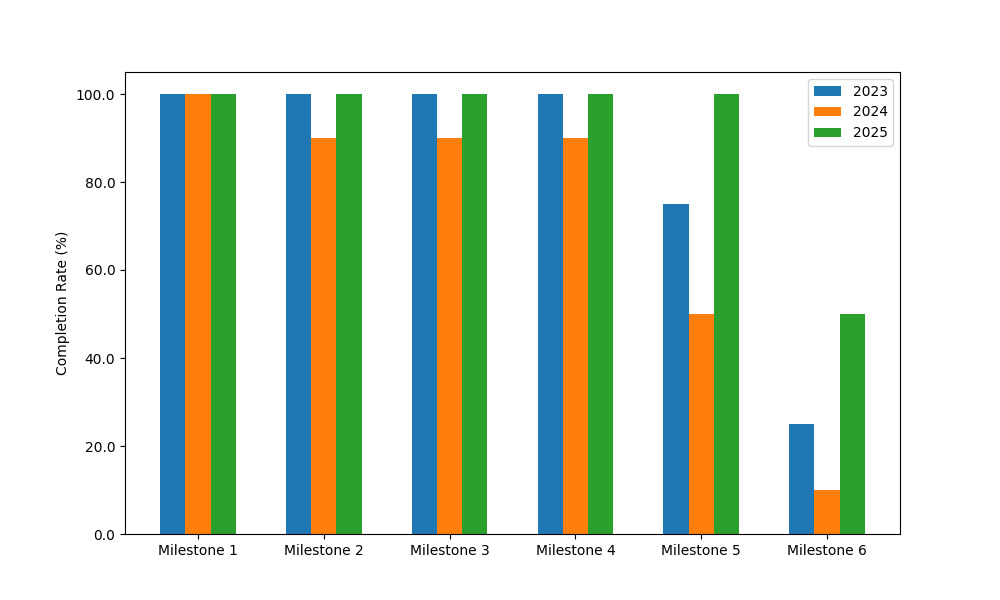
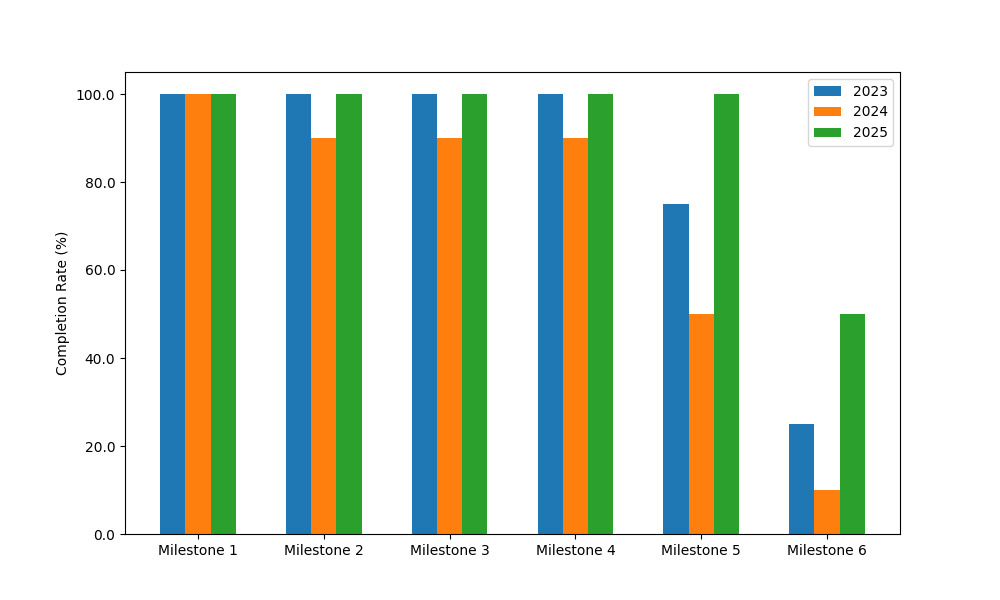
The comparison of completed milestones from 2023 to 2025 are shown in Figure 2. Milestones 1-4 were completed by all or nearly all student teams (or individual students in 2024) in each of the three years analyzed. Milestones 5 and 6 exhibit a comparatively steep decline in completion rate for 2023 and 2024, with significantly higher rates of completion in the 2025 when genAI usage was integrated into the curriculum. Specifically, completion rates were 75%, 50%, and 100% for milestone 5 and and 25%, 10%, and 50% for milestone 6 for 2023, 2024, and 2025 respectively.
5.2.2. Student Final Grades for 2023, 2024, and 2025 Computer Analysis of Power Systems class
Preliminary screening of the course grade data revealed differences in the patterns of the spread of final course grades between the two years. The 2023 and 2024 cohorts were characterized by a wide range of outcomes and the presence of extreme low-end outliers. In contrast, the 2025 cohort exhibited a strong ceiling effect, with a high frequency of students achieving the maximum possible score of 12.00.
Given these distributions, the median and Interquartile Range (IQR) provided the most accurate representation of cohort performance. The 2023 and 2024 cohorts both achieved a median of 11.63 (IQR = 2.44 and 2.25, respectively), while the 2025 cohort achieved a median of 12.00 (IQR = 0.75) (Table 4).
A Kruskal-Wallis test indicated no statistically significant differences in grade distributions between the 2023, 2024, and 2025 cohorts (H = 0.806, p = 0.7). Despite the considerable shift in the mean caused by 2024 outliers, and to a lesser extent in 2023 grades, the rank-based analysis confirms that the central tendency of student performance remained stable across both academic years.
Although performance in the class was similar, a comparison of group variability revealed a notable shift in the consistency of students’ grades. A Brown-Forsythe test for equality of variances was not statistically significant, F(2,38) = 2.56, p = 0.09. Although not significantly different, the similarity in medians and IQR for the 2023 and 2024 cohorts, coupled with the reduction in IQR from 2.44 and 2.25 (respectively) to 0.75, suggests greater academic stability in the 2025 cohort than in 2023 and 2024, particularly when student GPAs are similar before and during this class (Table 3). The data suggests that the scaffolded use of genAI in this project-based learning course during the Spring of 2025 lessened the wide performance gaps and low outlier grades observed in 2023 and 2024. Furthermore, a two-tailed Independent Samples T-Test was conducted to assess the difference between undergraduate and graduate performance in the 2025 cohort. No significant difference was found between the two groups (T=1.37, p=0.187).
5.3. Analysis to Address Research Question 2
To address Research Question 2, we analyzed student course evaluation data, including both quantitative Likert-scale responses and qualitative open-ended feedback, as well as pre-course motivation survey results to examine changes in student motivation and persistence.
5.3.1. Student Evaluation of Instructor Effectiveness: Quantitative
At the end of the course, the university’s Office of Measurement and Evaluation of Teaching (OMET) sends students a survey containing questions about their assessment of the instructor’s teaching effectiveness. Eight of the questions are Likert-scale items rated on a five-point scale, with 5 indicating the highest score and 1 the lowest. The survey also provides three open-ended questions for students to provide additional feedback on key areas of evaluation.
Student evaluations of the Computer Analysis of Power Systems class instructor’s effectiveness were consistently high across both years and comparable to departmental (ECE) and school-wide benchmarks. Overall instructor ratings averaged 4.53 (SD = 0.36) in 2024 and 4.57 (SD = 0.05) in 2025, which closely aligned with the corresponding ECE and school averages. This pattern was consistent across undergraduate, graduate, and combined cohorts, indicating that the instructor received similar effectiveness ratings from both the department and the school.
Table 5 contains the Likert scale breakdown and average of the eight evaluation questions that are used to provide the overall instructor effectiveness score with the comparison of scores between 2024 and 2025.
The following questions: The instructor stimulated my thinking, The instructor maintained an environment where students felt comfortable participating, and The instructor maintained an environment where students felt comfortable seeking assistance lent themselves as proxies to students’ motivation and persistence. The first two of those questions showed an increase of 0.2, from 4.6 in 2024 to 4.8 in 2025, while the third showed a decrease of 0.15, from a perfect 5 to 4.85. However, there is not much concern with the decrease in the average score of the third question, as 4.85 is a very strong score and a perfect 5 was obtained in 2024 largely due to the small sample size of 5. As such, there is overall evidence to support the claim that students’ motivation and persistence improved slightly in this iteration of the course.
5.3.2. Student Evaluation of Instructor Effectiveness: Qualitative
Table 6 presents the open-ended OMET survey questions and a selection of responses that highlight the impact of genAI on students’ assessments of the instructor and the course. Although these quotes reflect only responses from the 2025 survey (in which genAI was introduced), they indicate that students have expressed positive views about the role of genAI in facilitating and enhancing their progress in the course, thereby providing a motivational factor for learning.
These results reveal fairly promising trends, suggesting that students found AI overall useful, especially in the development of their code. However, given that this was only the first iteration of the course with genAI, students also revealed desired improvements in its integration in subsequent iterations of the course.
5.3.3. Motivation and Coding Background Survey
As noted, in 2025 we added the L-SRQ and the Coding Background Survey. Seventeen students completed both instruments. The majority were male (n = 11), with six female participants. Most respondents were Electrical Engineering majors (n = 16), with one participant each from Computer Engineering and Sustainable Engineering. Participants included nine undergraduates, seven graduate students, and one undergraduate taking the course for graduate credit. Two participants reported working full-time in industry. Most students had some exposure to programming; only one reported no prior coursework in coding, and two indicated no experience with Python, MATLAB, C/C++, or Java.
The majority (n = 12) had worked on group software projects, and four participants had prior experience testing software either in class or at work. Industry experience was variable: five participants had no industry experience, five had participated in co-ops or internships, and seven reported current or past industry work.
In response to the open-ended prompt, What does the phrase ‘software engineering’ mean to you?, participant responses were coded into thematic categories. Most responses reflected an understanding of software engineering as problem-solving (n = 10) and coding/programming (n = 9). A smaller number of participants mentioned the software development process (n = 5), including design, testing, and implementation. Only three participants referred explicitly to engineering principles, such as systematic thinking or design methods. Two responses were either vague or blank.
These findings suggest that problem-solving and programming are the most salient ideas associated with software engineering among participants. However, only a minority recognized the engineering aspect of the discipline, and a moderate number demonstrated an understanding of the broader development life cycle. A small portion showed limited clarity or confidence in their understanding.
Students’ motivation for taking the course was assessed using an adapted version of the L-SRQ. Results indicate that participants were primarily driven by autonomous forms of motivation. The average score for autonomous regulation was 6.2 (median = 6.2, standard deviation = 0.5), with a Cronbach’s alpha of 0.64, suggesting moderate internal consistency among the scale items. In contrast, the average score for controlled regulation was lower at 4.3 (median = 4.3, standard deviation = 0.8), with a Cronbach’s alpha of 0.55, indicating low to moderate consistency. These somewhat lower reliability coefficients are likely due to the small sample size (N = 17), which limits the internal consistency estimates.
The calculated Relative Autonomy Index (RAI) was 1.9, indicating high autonomous motivation. This suggests that most participants were engaged in the course for reasons that were intrinsically motivated and autonomous rather than extrinsically motivated or externally pressured. Specifically, the participant’s motivation likely stemmed from personal interest, alignment with their values, and a sense of purpose or meaningfulness in the course content. This overall pattern of results may be influenced by the course composition, which included a large number of graduate and upper-level undergraduate students. Additionally, these students are likely to have enrolled voluntarily, reinforcing the observed trends toward autonomous motivation, as this is an elective course. Hence, although these data reflect only the 2025 cohort, there is evidence that students were motivated to learn the course content. How this extends to persistence in the context of the augmentation of genAI remains largely unknown.
6. Discussion
Preliminary results indicate a high degree of autonomous motivation among students enrolled in the course, as reflected by the SRQ-L scores and open-ended responses. Students appear to be intrinsically interested in the content, which aligns with the course’s project-based structure and the opportunity to engage in authentic, hands-on work. This high level of motivation may contribute to the positive reception of genAI tools, which were used by a majority of students to support coding tasks and reinforce conceptual understanding.
Regarding research question 1, learning outcomes as measured by milestone completion rates and final grades on the students’ completed simulator projects, increased following the introduction of genAI usage in the course in 2025. Notably, in 2025, milestone 5 achieved a 100 percent completion rate, and the final milestone’s completion rate was approximately twice that of the next-highest year. Furthermore, the 2025 cohort included additional coursework before and after the six main milestones. Thus, even with increased the course workload, the 2025 cohort achieved higher, more consistent grades as compared to 2024.
Regarding research question 2, the usage of genAI appears to have increased student motivation and persistence in approaching complex engineering problems. Post-course OMET surveys cite the usage of genAI in tackling coding problems, with at least one student citing that it helped them utilize Python effectively, even though they had not used it prior to this course. The quantitative OMET scores highlight slight increases in students’ perceptions of the instructor’s effectiveness. We attribute part of this increase to students’ ability to utilize genAI to bridge specific technical gaps that in prior years they may have instead used in-class time with the instructor to resolve. With relatively minor questions on nuances of programming able to be resolved on their own using genAI, students may have been able to have more meaningful time with the instructor while in class, leading to an increase in their perception of the instructor’s teaching effectiveness.
Interestingly, while not all students used genAI tools regularly, those who did tended to use them with greater specificity and purpose, mirroring patterns seen in related studies (Economides & Perifanou, 2024). These students demonstrated higher confidence in their software development abilities and made greater progress on their simulator projects, suggesting that genAI may serve as a valuable companion in PjBL contexts, especially for self-regulated learners.
There are several limitations to our study. The sample size is small and restricted to a single institution, and student self-reporting introduces potential bias. With that said, use of nonparametric statistics allows inferences to be made, and although use of self-reporting can induce bias, the majority of responses trend in the positive direction. Additionally, it remains difficult to separate the effects of genAI from other instructional factors such as instructor support, course structure, or peer collaboration. Furthermore, examining variations in impact across academic performance bands was not feasible in this study. The 2025 class cohort exhibited a strong ceiling effect in final course grades, with an IQR of just 0.75 out of a possible 12.0, leaving insufficient variability to detect meaningful differences across performance bands. Given the small sample size, this restricted grade distribution did not provide the statistical power necessary for subgroup analysis, and remains a priority for future work and additional cohorts. Future work may also explore these questions across multiple cohorts and institutions, potentially using experimental or quasi-experimental designs.
Concerning suggestions for future research, our first idea is to examine if the implementation of genAI broadens access to those without traditional ECE backgrounds, such as those on sustainability tracks. Those with traditional ECE backgrounds are naturally exposed to the requisite coding work and thus make a natural transition to the course, but given the improvement in motivation and project outcomes that we noticed in the past iteration of the course with genAI, we are interested in if genAI can also accelerate the development of those outside the ECE program.
7. Conclusion
This study provides evidence that integrating genAI into a fully project-based, mastery-oriented power systems course can support higher-order student learning without diminishing rigor. By positioning genAI as a developmental scaffold rather than a solution generator, students were able to allocate greater cognitive effort to synthesis and evaluation (the highest levels of Bloom’s taxonomy) while constructing a full-scale power systems simulator (Anderson & Krathwohl, 2001; Bloom et al., 1956). Improvements in advanced milestone completion and reduced performance variability suggest that genAI, when coupled with demanding design tasks, may help students maintain motivation and sustain progress on complex engineering.
From an instructional design perspective, these findings highlight several implications for faculty seeking to integrate genAI responsibly. First, genAI appears effective when embedded within a well-structured project-based learning environment that includes clearly articulated performance criteria, frequent formative feedback, and requirements for students to explain and defend their technical decisions (J. Biggs, 2003; Stefanou et al., 2013). Second, framing genAI as a tool to reduce cognitive load associated with implementation details, while preserving responsibility for modeling assumptions, algorithm selection, and validation, supports alignment between learning objectives and assessment (Sweller, 1988). When used carefully, genAI can elevate rather than replace student thinking, enabling learners to operate at the advanced cognitive levels desired in upper-division and graduate engineering education.