1. Introduction
The U.S., along with many other countries, has recognized the importance of implementing computer science (CS) education at the pre-college level. Computer Science (CS) skills are crucial to improving both national and personal economic growth (Building Skills for Life, 2021). Although every U.S. state has adopted CS implementation policies for pre-college students, access to CS remains uneven and inequitable, with minoritized students, English language learners, students with disabilities, and students from low socioeconomic backgrounds more likely to attend schools that do not offer foundational CS (Code Advocacy Coalition et al., 2024; Dunton et al., 2022). Since “access determines interest” (Margolis et al., 2008, p. 62), students at schools that do not offer CS have few opportunities to explore and develop an interest in it.
One looming obstacle to extending CS education to underserved populations is the lack of teachers who can deliver CS content in the classroom. States are struggling to define teacher certification programs in CS (Wendt & Apugo, 2019); and often these certifications are for high school only and do not cover multi-subject credentials common at lower grade levels (Code Advocacy Coalition et al., 2024). This shortage of certified teachers prompts schools to find alternative ways to incorporate CS into the curriculum.
One way to combat these issues has been to integrate CS into other courses. Students in grades 7-12 have been shown to exhibit nearly equal interest in learning CS when it was taught as part of another class as when it was offered by itself (Wang & Hejazi Moghadam, 2017). Furthermore, this approach addresses credentialing constraints by allowing teachers to continue teaching within their certified subject areas, while also extending CS access to underserved students (Code Advocacy Coalition et al., 2024). At the same time, CS integration means that the teachers are teaching out-of-field for the CS portion of their work.
Some schools have been addressing the issue of out-of-field teaching through collaborations with nearby universities in K-16 partnerships. These partnerships provide schools with much-needed support in CS education while also offering university staff insight into school culture and student populations (Dishke Hondzel et al., 2019). These partnerships often include undergraduate students going into the classroom, but there is little literature about the roles that the undergraduates play in the classroom (Domina & Ruzek, 2012).
This study examines undergraduate actions and interactions in the classroom as part of a K–16 partnership supporting integrated art and CS instruction. Prior studies have examined, at a macro-level, the effects and benefits of having undergraduates involved in K-12 outreach and in-class activities (Eppler et al., 2011; Penn et al., 2025). However, little is known about the nature of interactions that undergraduates have with the individuals and environments they encounter in their service activities. Therefore, this study answers the research question:
What types of actions and interactions do undergraduate service learners engage in when working in the classroom as part of a K-16 partnership?
2. Literature on Undergraduate Engagement in K-12 Facing Programs
Across many disciplines, several programs have utilized undergraduate students to enhance K-12 learning environments. Undergraduates have served as K-12 mentors and tutors, planned and executed outreach events and activities, and contributed to the development of K-12 curricula (Domina & Ruzek, 2012). For community partnerships focused on computer science or engineering, service-learning can play a significant role in community engagement (Bringle & Hatcher, 2009), with undergraduates fulfilling an important role in the K-12 domain.
2.1. Mentoring and Tutoring
One-to-one and one-to-many interactions between undergraduates and K-12 students are prevalent in programs that involve long-term mentoring or tutoring of pre-college students. In one partnership between a university and a school district in the U.S. West, undergraduate students were hired as tutors for the school district’s students (Domina & Ruzek, 2012). In another program, undergraduates enhanced the learning community during the COVID-19 pandemic by providing semester-long supplemental online STEM teaching to groups of primary school students. The undergraduates prepared and taught virtual reality and hands-on, at-home experiences to help primary students learn about various topics (Chen & Ng, 2022). In a service-learning program, freshmen psychology students were paired with at-risk elementary students for two hours of reading tutoring per week, resulting in modest improvements in reading and possible shifts in achievement motivation (Eppler et al., 2011) These programs showcase the variety of ways in which undergraduates have contributed to the K-12 community through service and personal interactions with students.
Undergraduates have expressed an understanding of their role in working with K-12 students and the varied nature of their interactions with them. Carroll (2014) examined undergraduate perspectives of their experience mentoring middle school students in design thinking and STEM by asking them to reflect on their 7-week-long experiences in an after-school program. The undergraduates acknowledged the need to get to know students as people and described their mentoring interactions as providing inspiration for students, defining their role with students, balancing authority, making connections, building rapport, and building a team culture. Although the undergraduates “didn’t have all the answers” for students (p. 16) their willingness to prototype and figure out answers with the students enabled them to build their own and the middle school students’ confidence in their creative abilities.
2.2. Events and activities
Longer-term and even one-time interactions between undergraduate engineering and computer science students and K-12 students help spark interest among pre-college students. These interactions may be in the form of one-time presentations, recurring programs, or outreach events. One-touch interactions occur during events or presentations that do not span more than one day with the same K-12 participants. For example, the Engineering Ambassadors Network, which trains undergraduates to conduct STEM outreach through one-day school presentations and hands-on activities, has been successful in generating interest in engineering among K-12 students nationwide (Garner et al., 2016; Mosleh & Marin-Artieda, 2017; Wei & Hill, 2018). In another program, undergraduate and graduate service-learners developed presentations to showcase their capstone projects to high school students, resulting in increased knowledge of and interest in engineering among the high schoolers (Munoz-Medina et al., 2021). Longer-term interactions, in which undergraduates interact with the same group(s) of K-12 students, may last several weeks. For example, as part of a one-semester introductory engineering course, undergraduate students at a Texas university spent two to eight weeks assisting teachers and K-8 student teams with introductory LEGO robotics, in preparation for the robotics tournament that undergraduates also organized. Teachers in this program expressed appreciation for the freshmen “engineering experts” because this was their and their students’ sole exposure to engineering (Karp, 2011). The Student Teacher Outreach Mentorship Program (Portsmore et al., 2003) at Tufts university pairs undergraduate and graduate engineering students with K-12 educators to support them in implementing engineering focused curricula. In this program university students help K-12 students in the classroom with hands-on projects and work with teachers, outside of school hours, to familiarize them with engineering concepts. In another program, based in Australia (Sheehan & Mosse, 2013), university students run science labs at the university, for new and out-of-field secondary science teachers and their students, providing equipment and expertise that is inaccessible at their under resourced schools. This program has been shown to help teachers develop specific content knowledge and provide deeper learning for students. Whether in one-time or longer-term interactions, undergraduate involvement in K-12 environments has been shown to positively impact teachers and students.
2.3. Curricula
Due to their more in-depth knowledge of engineering, science, and mathematics, undergraduate students have contributed to K-12 curriculum development. For example, in a first-year engineering course, students developed lesson plans to help teachers with limited robotics experience (Karp, 2011). In another instance, engineering students partnered with pre-service teachers to co-create robotics activities centered on teaching mathematics and science (Bers & Portsmore, 2005). In some cases, engineering students also served as co-teachers during classroom implementation using the tools they helped develop. These studies demonstrate undergraduate engineering students’ ability to translate complex topics to a K-12 level.
Undergraduates involved in mentoring, tutoring, outreach activities, and curriculum development aimed at the K-12 space share their knowledge and experiences to create a positive impact on K-12 students. In this way, regardless of the specific domain of knowledge, undergraduates’ relatively advanced knowledge allows them to make significant contributions to the K-12 environment.
Community organizations, including K-12 schools, have identified the benefits they receive from participating in a broad spectrum of service-learning partnerships (Sandy, 2007). More specifically, out-of-field pre-college CS teachers have recognized the in-class benefits they receive from undergraduate service learners’ support in the classroom (Penn et al., 2025). Undergraduate service learners have identified, from their perspective, the role that they play in supporting K-12 settings (Carroll, 2014). Despite university-community partnerships having shown statistically significant benefits, little is known about how they achieve these results (Domina & Ruzek, 2012). Additionally, universities engaged in K-12 school partnerships often lack an understanding of the community or engage stakeholders in limited ways (D. E. Collins et al., 2009). Also, while undergraduates have a perspective on their interactions in STEM engagement with K-12 students, these interactions have yet to be observed or confirmed through close examination of their behavior in the environment. Thus, one area ripe for exploration in community partnerships employing undergraduates in service-learning is the roles undergraduates play in engineering service-learning partnerships with K-12 schools. We can do this by observing and categorizing their interactions in the environment. Therefore, this research aims to better understand undergraduates’ service-learning role by looking at their interactions in a semester-long engagement with a K-12 classroom.
2.4. Theoretical Framework
Undergraduates in K-12 schools become part of the school community. Vygotsky’s views on constructivist learning emphasized the social influence of community in children’s education. His theories of the zone of proximal development rely on sociocultural aspects of the environment and on collaboration between the learner and a more knowledgeable other (MKO; Tudge & Scrimsher, 2014). In the K-12 classroom, an MKO can be the teacher or a peer. Undergraduates in engineering-focused service-learning may contribute to the classroom by acting as more knowledgeable others. Additionally, undergraduates, as nearer peers to middle or high school students, may have greater opportunities to engage in cognitive apprenticeships with students, in which they make their thinking processes about computing and design explicit (Brown et al., 1989). The presence of undergraduate students in the K-12 classroom in an interjacent role, lying somewhere between the teacher and students, will affect the classroom’s participation structure. Jordan and Henderson’s (1995) work on interaction analysis focuses on the participation structure of the classroom because analyzing participation structures is “essential to understanding interaction in formal school settings” (p. 69). These interactions are analyzed at the micro-level to examine what people say, do, and think (R. Collins, 1981). Examining micro-level interactions between undergraduates, students, and teachers in the classroom may provide insight into how undergraduate service-learners benefit K-12 community partners at a micro/classroom level.
3. TechArt Program Description
The K-16 partnership under study in this paper, TechArt, centers on curricula that integrate art with physical computing and engineering design at both the middle and high school levels. At the middle school level, students learn physical computing and cardboard design and construction techniques. They also progress through an engineering design process to create interactive artifacts for a TechArt summit held at the partner university. Undergraduate engineering, computer science, design and math majors participate in a service-learning course in which they are trained by faculty to act as consultants to a K-12 classroom, helping the teacher and student teams to progress through the curriculum and create culminating artifacts. The undergraduate training is typically conducted during the first 1-2 weeks of the semester, before students are sent to the K-12 classrooms. Students are trained in how to code all components of the physical computing kit (Birdbrain Hummingbird and micro:bit). Undergraduates are asked to provide a demonstration of competence in programming the kit before serving in the K-12 classroom. They are also trained in cardboard construction techniques and how to create simple mechanisms using the computing kit and craft materials. Students are given a brief explanation of learning theory as it relates to their role in the classroom as more knowledgeable others and encouraged to verbalize and make their thought processes transparent when assisting students. In the K-12 TechArt classroom, undergraduates use their domain-specific knowledge to support teachers and students with concepts in computer science, engineering, and artistic design. The consultant’s responsibilities include working in the classroom one to four times per week to assist the teacher and mentor students in completing the TechArt curriculum and culminating projects.
4. Methods
In this study, we examine aspects of undergraduates’ classroom interactions with the teacher, university faculty, and students. To better understand undergraduates’ classroom actions and interactions, we use qualitative methods to categorize interaction themes. After developing the themes, we use frequency analysis to prioritize further analysis of the most prevalent themes.
4.1. Background and Setting
This study was conducted at a middle school classroom with an out-of-field teacher. The middle school serves primarily Black and Hispanic students, with 62% of students receiving free or reduced lunch. The elective TechArt class met twice weekly during the 16-week Spring semester, with each session lasting 50 minutes. The teacher only covered the scripted TechArt curriculum on days that the undergraduate students were in the classroom. Additionally, the professor for the undergraduate service-learning class attended all except one session to collect data, provide minimal support to the teacher, and supervise the undergraduate students.
The teacher for the middle school class, Mr. Clay (alias), was trained and hired as a social worker for the school and assigned by the school administration to teach what the school designated as a coding class. Mr. Clay received a brief training during the Summer and apprenticeship training during the Fall prior to the semester under study.
Two undergraduate students participated in the Spring pilot service-learning class and were labeled as “consultants” sent by the university to help students complete their TechArt projects. These participants were recruited from the service-learning class, and their grade for the course was not affected by their participation in research activities. The participants agreed to allow the researcher to use their recorded classroom activities as data. The “consultants” were Micah, a computer science major, and Daniel, a design studies major, both seniors at the university. Micah had work experience teaching pre-college students to code and had participated in the Fall 2025 apprenticeship training for Mr. Clay. Daniel had no experience working with pre-college students but desired to mentor underserved students to consider college and, possibly, design studies. For this early pilot of the TechArt program, although Micah and Daniel were cross trained in computing and design as part of the service-learning class they naturally felt most proficient in their major specific domain expertise.
The spring semester’s middle school classroom consisted of sixteen 6th-, 7th-, and 8th-grade male students who had chosen to enroll in the elective class.
The university faculty over the service-learning class was also present in the classroom to collect data. The intention was that the faculty would have minimal involvement in the classroom beyond data collection.
4.2. Data Collection
The classroom was videotaped for fourteen sessions, covering all except one day when the teacher taught the TechArt curriculum. A researcher set up two cameras on opposite sides of the classroom and placed a Lavalier microphone on the teacher and the undergraduate students. Two cameras were needed to capture interactions throughout the dynamic classroom. Although students had assigned seats, they often performed significant work away from them at task-specific stations. Over twenty hours of video data were collected.
4.3. Data Analysis
Utilizing processes outlined in The Cambridge Handbook of Group Interaction Analysis by Brauner et al. (2018), we defined two units of observation for coding undergraduate interactions. The first unit of observation was undergraduate 1-1 or 1-N engagement with other actors in the classroom. This observation unit starts when an undergraduate is physically or verbally involved in direct interaction with a particular actor or group. The unit ends when the undergraduate physically or verbally disengages from the interaction with the actor or group and moves on to another unrelated action or interaction. The second unit of observation was undergraduate actions that did not involve engagement with another actor. This type of unit involved times when the undergraduate was physically active in the classroom but not directly interacting with a person. Such actions include cleaning, setting up or distributing materials, or otherwise engaging in classroom activities, but not directly interacting with another person. We used MAXQDA to mark video segments that captured the entire interaction or marked the occurrence of an action.
Upon completing our analysis, we identified 405 segments, consisting of an observed action or interaction performed by undergraduates in the classroom, and loosely grouped those segments into themes. Our analysis revealed several high-level themes and subthemes describing undergraduates’ actions and interactions in the classroom. We consolidated and subdivided themes, performed a frequency analysis of the occurrences of each theme (Rack et al., 2018) and removed thematic codes with an occurrence rate of less than 5%. The frequency analysis guided our deeper qualitative analysis of the most prevalent themes. For the purposes of this research, due to space constraints, we present the qualitative findings and excerpts of dialogue and interactions between actors using an abridged format.
Given the introduction, literature, methods, and results written by the authors, ChatGPT was used to draft an outline for the discussion section of this paper. The authors verify that all text in the discussion section was written by them and that no artificially generated content was used.
5. Results
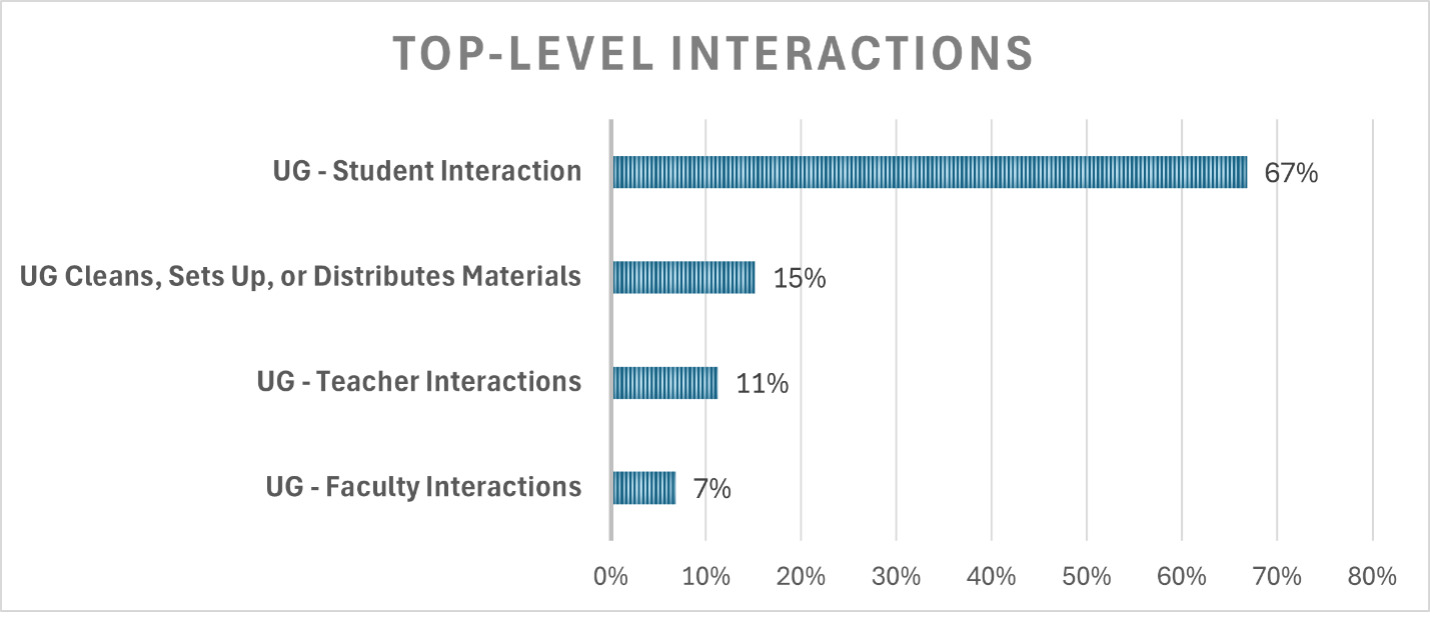
The findings from this study show that the interactions of undergraduate (UG) students involved in longer-term service-learning in a K-12 classroom are divided into four major themes: (1) Interacted with students; (2) Performed clean up, setup, and materials distribution; (3) Interacted with the classroom teacher; and (4) Interacted with the university faculty present in the classroom. Each of these themes had more than a 5% occurrence rate (see Figure 1). The results section will be divided into two major sections: interactions with students and with non-student actors. The interactions with students were the most prevalent theme and provided the richest information for describing the value of the undergraduate in the classroom. This theme was further divided into subthemes. In each section below, we present a frequency analysis, followed by classroom examples to illustrate the types of interactions the UG service learner engaged in during the experience.
5.1. Undergraduate Interactions with Students
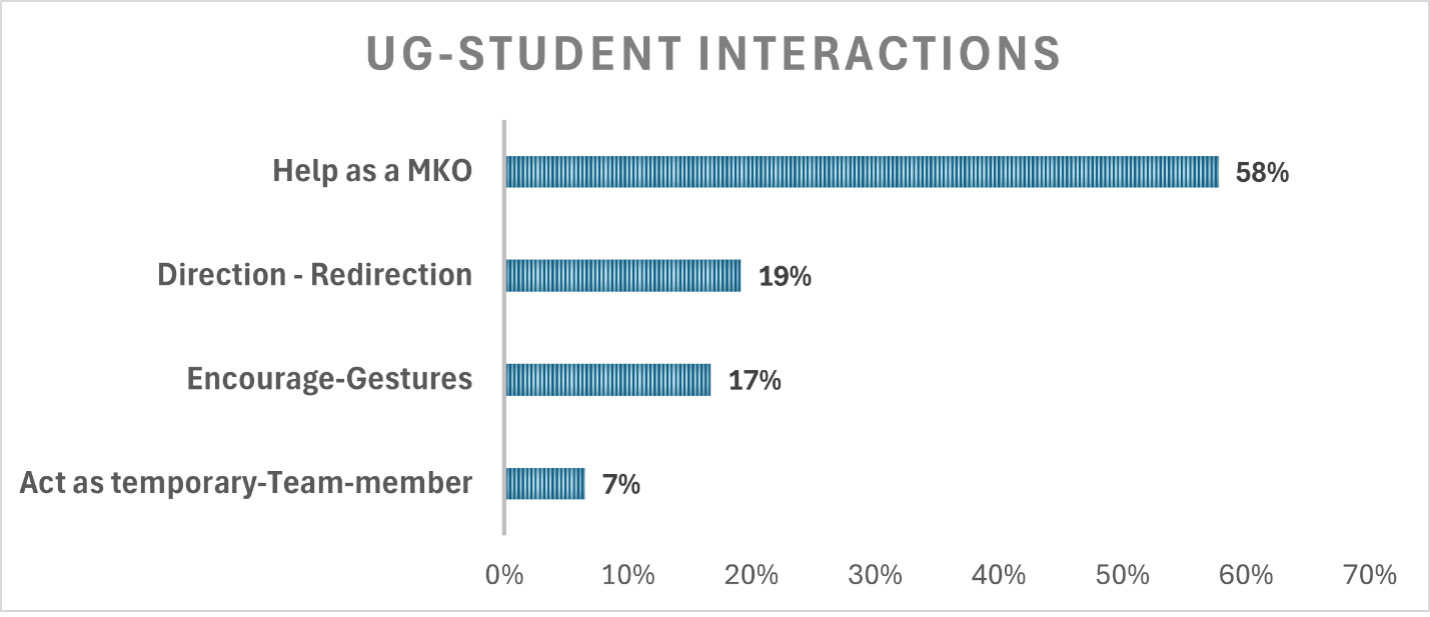
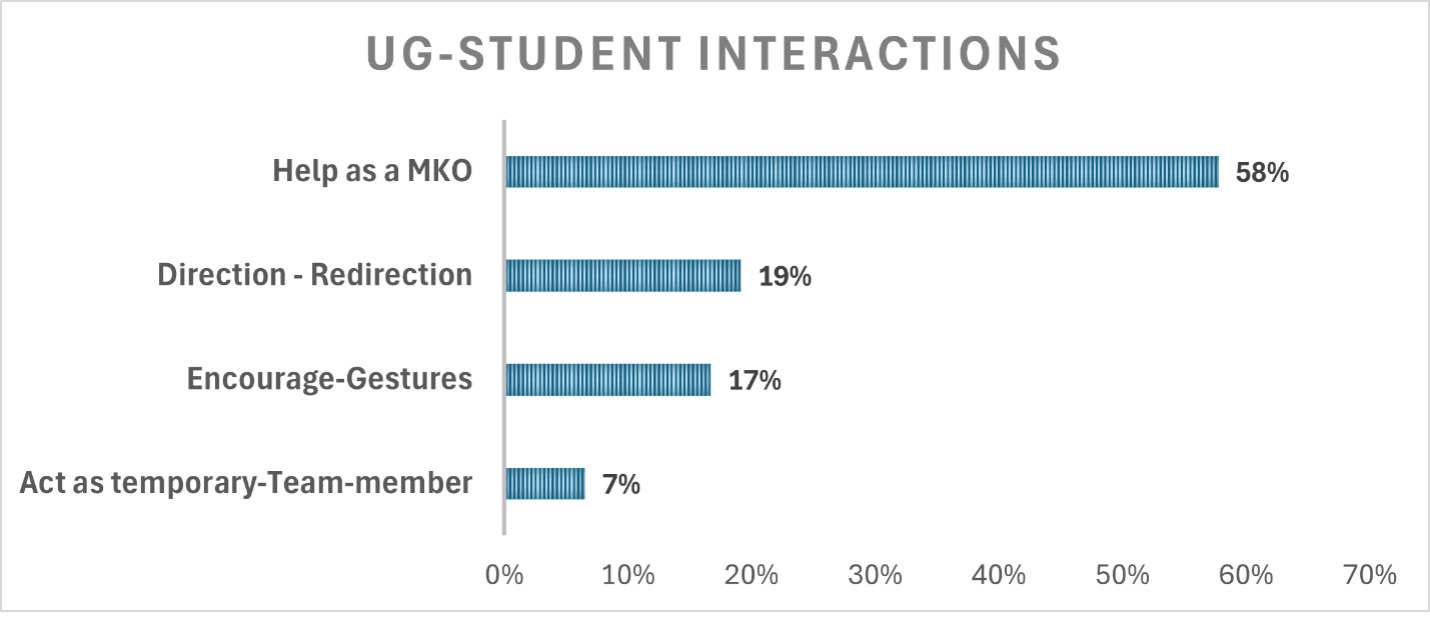
The UG-student interactions accounted for 2/3 of the top-level occurrences and were further subdivided into sub-themes. The sub-themes were pared down to only those with a frequency of 5% or more. The interactions between undergraduate and middle school students were categorized into sub-themes: (1) Acting as a more knowledgeable other (MKO) to students; (2) Encouraging students through words or gestures; (3) Providing direction or redirection to students; and (4) Acting as a temporary team member (see Figure 2). We will present each sub-theme through example interactions with discussion.
5.1.1. Acting as a More Knowledgeable Other
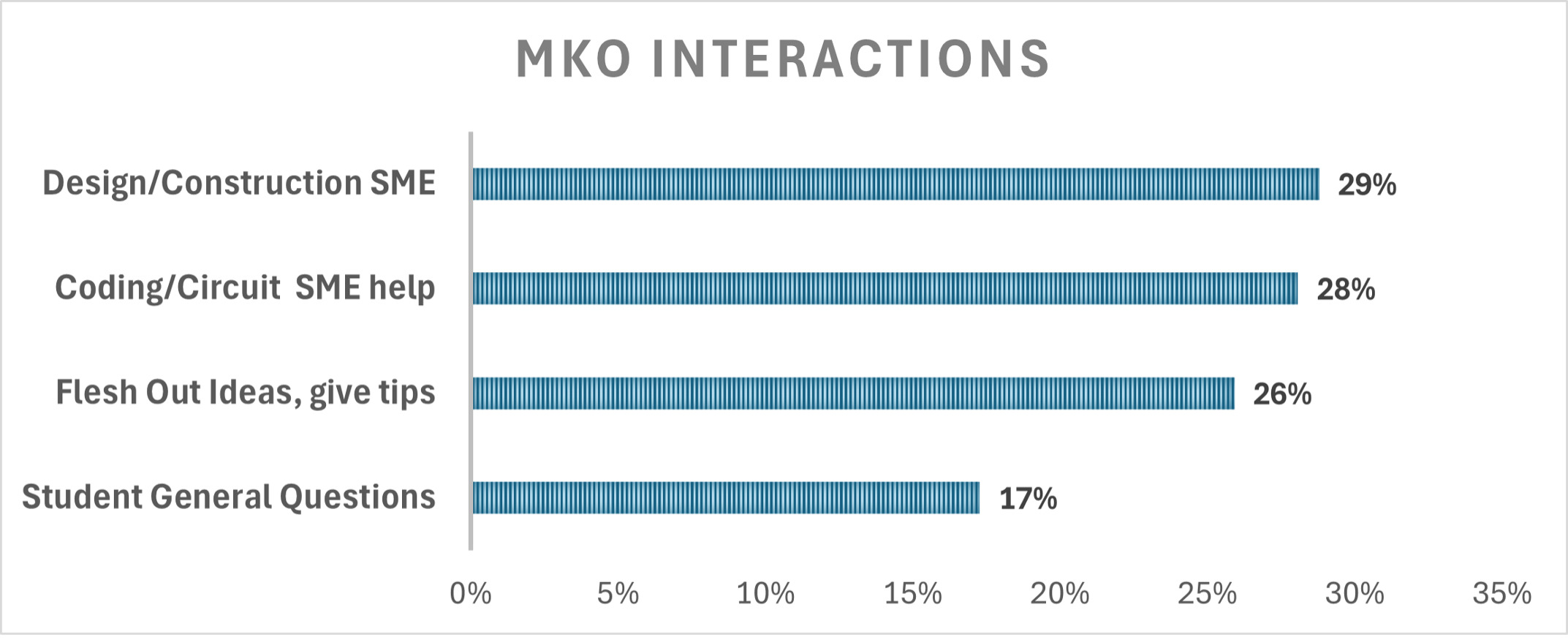
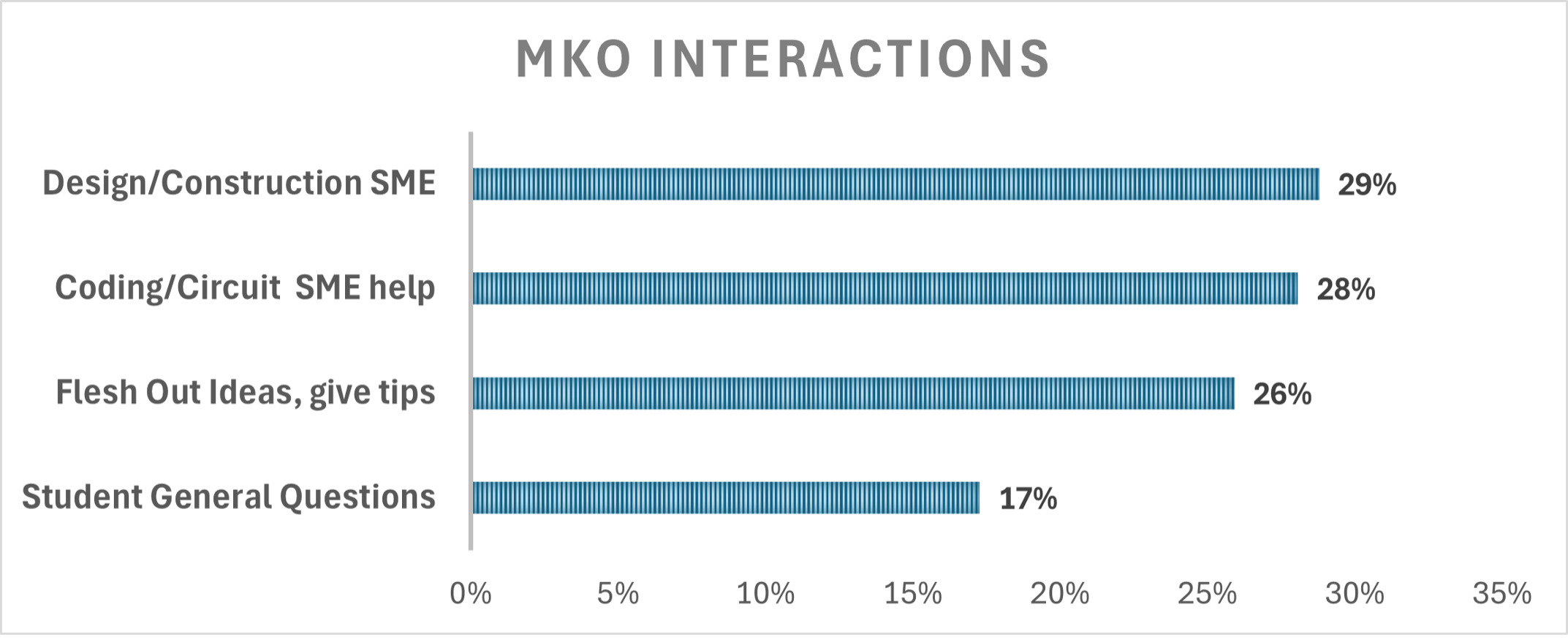
The UG service learners primarily served as MKOs in the classroom. This was particularly useful in this setting, where the teacher was out-of-field. The data revealed several subthemes of how the UGs behaved as MKOs: (1) design and construction subject matter expert (SME); (2) coding and circuitry SME; (3) help with fleshing out and discussing the substance of student ideas; and (4) answering students’ general questions (see Figure 3). Throughout the examples below, we see that the undergraduates provide a level of cognitive apprenticeship to the students as they walk through, talk through, and demonstrate their own process. By doing this, the undergraduate MKOs allow students to become independent thinkers who are more able to implement practices on their own.
5.1.1.1. Design/Construction SME
Undergraduates acted as design/construction SMEs and were often asked by the teacher to assist students. In this example, Mr. Clay noticed that Aidan was struggling with implementing his detailed design. Aidan had an idea of what he wanted but was not yet capable of accomplishing it independently. Mr. Clay asked Daniel to help him.
Daniel: What do you need help cutting?
Aidan: I’m having a tough time [unintelligible] ladder.
[Daniel begins making fine cuts on a piece of cardboard on which Aidan has made an outline of his design. Daniel sees that the current effort is not feasible.]
Daniel: I think we need to make a new one.
[Aidan shows Daniel the cardboard he has in his hand.]
Daniel: Tell me where you want to cut.
[Aidan begins explaining. Then he gets another piece of cardboard and begins drawing on it. Daniel begins cutting, folding, and manipulating the cardboard, discussing and questioning each step with Aidan.]
Daniel: [As he’s cutting] I could cut it in half … So, like, cut this off? …So, you want me to cut this whole thing? … Do you want me to cut these two sides off? …
Aidan: “I got an idea!” [He picks up a piece of cardboard.]
[Daniel stops and focuses intently on Aidan as the student demonstrates his idea.]
Daniel: Uh-huh, okay.
[They continue working together as Daniel lets Aidan take the lead. Aidan completes the task using both his own and Daniel’s contributions.]
This interaction provides evidence of Daniel working as an MKO. As he demonstrated how he was implementing Aidan’s design, Daniel’s guiding questions and statements acted as scaffolds to help Aidan understand the thinking behind his process. This scaffolding process lasted several minutes. Suddenly, the student understood: “I got an idea.” Once Daniel realized that Aidan had grasped the concepts, he no longer asked guiding questions but took on the role of a temporary team member (discussed later in this section), “pitching in” on the work and allowing the student to complete it on his own.
5.1.1.2. Coding SME
In the technical aspects of writing functional code and building functional designs, the undergraduate students served as subject-matter experts in the MKO role. In these interactions, the undergraduates provided direct instruction or help with specific coding or wiring tasks necessary to complete the students’ projects. Often, the undergraduate helped students with troubleshooting malfunctioning components. The undergraduate either explained concepts or answered student questions about their desired outcome, walking them through its development. For example, Micah spent time helping Johnny (8th grade) work on code to avoid obstacles using a distance sensor on a car his team was building. Micah helped him troubleshoot the malfunctioning obstacle avoidance feature.
Micah: Johnny, what’s up with the car? … Is it the batteries? … You wanna bring your code and car over here so I can take a look at it?
[Micah models his thinking and process by talking through troubleshooting steps.
Together, they checked the wires, reviewed the computer code, and made adjustments. They found that the wheels were moving at times, but the car was not responding to the distance sensor as expected. Micah studied the code and observed a problem, explaining it to Johnny.]Micah: What you had in the code before was basically saying (pause) if it didn’t see anything in front of it don’t move. If something got in front of it (pause) move. I want you to go back to your old code, and I want you to change it so that if there’s nothing in front of it, it just moves forward, and then if something gets in front of it, it stops moving. Okay?
Johnny: [unintelligible response from Johnny – however, Micah’s response indicates that his answer was in the negative]
Micah: Okay. I’m going to write on the board the pseudocode, and then I want you to code it, okay.
[Micah and Johnny continued in this way through iterations of Micah assisting with pseudocode, then Johnny coding.]
At the beginning of this interaction, Micah acted as an MKO by recognizing that Johnny was struggling. Micah demonstrated this by first asking questions and then working with Johnny to troubleshoot. Throughout the troubleshooting process, Micah continued to articulate his thinking, thus modeling his methods for Johnny. Towards the end of this interaction, Micah noticed a mistake in his work (that he provided the wrong condition for an if statement in the pseudocode) and brought it to Johnny’s attention. Here, Micah also worked as an MKO by identifying his own mistakes and ensuring the student saw and understood that mistakes were part of the process. Lastly, after all coding was finished and the car was working as expected, Micah congratulated Johnny, showing his camaraderie with the student by fist-bumping.
In another MKO coding example, Micah helped Sanil (6th grade) with a car he was building to drive around an oval-shaped racetrack his teammates were making. Micah had previously worked with him over several sessions. On this day, Sanil had already spent the first third of the class writing code to make the car move forward. Micah acted as an MKO and spent much of the remaining class period sitting with Sanil, advising him. After a successful test of the code Sanil has just written, Micah interrupted Sanil’s immediate desire to tinker with code, trying to get him to think before coding.
Micah: “So, here’s my idea.”
[Sanil interrupts and turns the computer toward himself, as if he wants to change the code.]
Micah: Sanil, no. think about this … Think about that oval [gestures to draw an oval in the air]
[Unintelligible response from Sanil – however, Micah’s response indicates that Sanil mentions the code he’s already written and tested.]
Micah: That’s our test but let’s think about this, Sanil. So, we have a car within this oval (gestures) but we can’t turn like a normal car right? So, what I was thinking is do this…
[Micah explains his plan for coding the car to navigate around the oval-shaped track using the distance sensor.]
After the explanation, Micah angled the computer slightly toward himself and began typing in code. He directed Sanil to place the distance sensor on the front of the car. They worked together for several minutes, Sanil on the body, Micah on the code. As Sanil wired the distance sensor, he utilized Micah as an MKO by checking in with him on which wires went where. This next excerpt begins with Sanil mentioning an idea he had about adding another component to the project:
Micah: That’s not a bad idea. That’s a good idea. (pause) That’s a great idea.
[observing Sanil place the distance sensor]
Let me see this. I know what you’re thinking but in order to make it as stable as it could be what if we just put a bunch of tape on here and then we’ll glue it.[Micah takes the car to another table and glues the distance sensor in place. He returns and places the car on the table in front of Sanil.]
Alright, I only did it because I want to get this done fast.
Above, we see Micah encouraging Sanil’s idea (theme discussed in a later section). We also saw Micah performing more work on the project than is appropriate, taking it over for expediency’s sake. However, as troubleshooting time extended, we saw that Sanil’s prior cognitive apprenticeship under Micah had made him more assertive in his troubleshooting approach. Even as Micah continued in his role as an MKO, we observed the duo play into the near-peer nature of their relationship, with Sanil pointing out errors and proposing his own troubleshooting ideas.
Sanil: I see why. Give me this thing [reaches for the car]. Give me this thing [takes the car back from Micah] I think I know why…
[Sanil catches an error in the code and points it out to Micah]
Micah: Oh wait that’s a light, yeah. Good catch.” [Holds up his fist for a fist bump. Sanil taps Micah’s fist with the back of his hand.]
Micah: [changes the code] Alright, upload that code. Nice man. I was like ‘why is this not working?’
[In a later troubleshooting step, Sanil suggests changing out the distance sensor]
Micah: It was the distance sensor, so you were right. It wasn’t working because the distance sensor we were using before was faulty. But when you put a new one on there, it worked better.
In these examples with Johnny and Sanil, Micah, acting as an MKO, modeled extended troubleshooting, readily admitted mistakes, and scaffolded instruction as the student displayed capacity for more. His prolonged interactions with each student over the course of the semester developed a near peer level of comfort and familiarity between him and the students. Micah modeled troubleshooting by speaking his thought process aloud. As the semester progressed, the students began to view Micah as an MKO with whom they could collaborate. The relationship between Micah and each student took on a near-peer nature, with Micah providing ideas and direction as well as taking ideas and direction from the student. This was especially evident in Micah’s interactions with Sanil, who felt empowered to collaborate with and suggest corrections to Micah. Also evident in the interaction between Micah and Sanil was Micah’s overreach in working on the project. Micah seemed to have taken the collaboration to the point where he partially took over the work, writing the more complex code for Sanil and, later, leaving Sanil at his desk while Micah glued and later tested the car on the track. At the end, Sanil seemed to have grown tired of the car, as he did not participate in testing the car on the track until Micah called him over. The students’ lack of interest in testing the car may have stemmed from Micah taking over a significant portion of the work. Notably, there was only one other similar incident in which the undergraduate, Daniel, performed work on behalf of the student, rather than coaching the student through the work. Incidents of undergraduate overreach only occurred in 1% of the interactions and are thus not included in Figure 3.
In several coding/circuit SME instances, the undergraduate also acted as an MKO by providing extended individual instruction to capable students who wanted to add components to their projects that were not covered in the basic instruction they received. For example, as an MKO, Micah showed Isaac (6th grade) how to hack a fairy light to work with the Hummingbird. The process involved detaching the light from the battery, coding the single-color LED port on the Hummingbird, and testing the fairy light’s polarity. In a prior class session, Micah had Isaac focus solely on writing the code. Micah demonstrated how he cut the fairy light, tested its polarity, and wired it to the Hummingbird. In a later class, Isaac wanted to add another fairy light to his project.
Micah: “Isaac. You already know how to code it, so I’m going to let you do it this time. Remember what I did last time. I just plugged one in, and if it didn’t work, I just reversed it."
Isaac: “Yeah, you tied a knot-”
Micah: “You tie a knot on the negative one…once you figure out the way it works, okay?”
Isaac: “Yeah”
[After Micah provides him with the fairy light, Isaac independently codes, hacks, and attaches it to his project without any further assistance from Micah.]
Here we have evidence of how Micah’s prior work as an MKO for Isaac has paid off. In this interaction, Micah gave Isaac the opportunity to do both the coding and wiring on his own. Because Micah had already shown Isaac the procedure in a prior class, Micah only needed to provide a brief reminder of the steps, and Isaac was able to complete the specialized task independently.
In another instance of providing advanced instruction as an MKO, Micah helped Aidan (6th grade) to explore another lighting option for his project. Aidan had already incorporated the required electronic components into his project and expressed a desire to add bright lights. Micah, seeing that Aidan had demonstrated the ability to grasp a more complex lighting option, coded a Neopixel strip outside of class and brought it to class to demonstrate it as an option to the fairy lights. Micah let Aidan experiment with the Neopixel strip and provided focused instruction on how to code it. Aidan incorporated the Neopixel strip into his project.
In these examples, the undergraduate had a clear understanding of both the student’s project goal and the student’s individual capabilities. The undergraduate acted as an MKO by offering advanced individual options and instruction to students ready to grasp higher concepts and incorporate more advanced elements into their projects. As an MKO, the undergraduate helped build the students’ confidence by showing them how to incorporate a non-standard component into their design. It’s important to note that the undergraduates provided advanced instruction only to those who had demonstrated their capacity for extended learning by completing most of their project work. Other students who expressed interest in the special components but had not completed enough work on their projects, were encouraged by the undergraduates to complete their original work before adding any special components.
5.1.1.3. Flesh out Ideas
Each classroom project consisted of student designs. Students brainstormed and sketched their project ideas, then set about building their projects, following the steps outlined in the curriculum. Often, students had an idea of what they wanted to build or how they would build it but needed affirmation that their idea was feasible or a discussion about its feasibility. At other times, undergraduates purposefully engaged students in discussions about their ideas to determine whether students were on track to build their desired artifact. In this example, it was late in the semester, and Jeff and Tony wanted to build something different from what they had been working on. Micah and Daniel listened to a team’s new project proposal and then discussed the feasibility of their proposed design.
Micah: So you guys are wanting to build a different project now right?
Tony: Yes
Micah: So what’s different about this project versus your project right now?”
[Tony and Jeff explain they want to build a transparent CPU tower with water flowing through it.]
Micah: You want water to be - actual water (pause) to be around electronic components?
Daniel: That’s technically not safe.
Micah: [explains the danger of water spilling] When you’re doing something like this with water, it has to be a specific type of tubing because it has to be like tight …
[tells them a way they could accomplish this with a pump, reservoir, and tubing]
Let me show you guys what I’m talking about. Would this be good enough for your project?[Micah brings up a picture on his phone, and the team discusses it. Then Tony and Jeff propose things that they would need to have to make the project work.]
Micah: I want you guys to right now to start drawing up what you want your next project to look like. You don’t have to spend the rest of the class, but I want you guys to at least spend ten minutes drawing and showing me, and like pointing out what you guys want to do with everything.
In this example, Micah gave great consideration to the students’ proposal. He did not dismiss their idea, despite its impractical feasibility, given the time left in the semester to accomplish it. Instead, he and Daniel listened to their ideas, and Micah contributed his own suggestions, describing how they could accomplish their design. In line with the curriculum, which required a sketch before teams could begin constructing their design, Micah ended this interaction by giving the team a direction: sketch their design. In doing this, he quickly pivoted his interaction from being an MKO to providing direction (discussed later in this section).
In another example, Micah helped Deon (7th grade) student flesh out his ideas and affirmed his work. As part of the design process, the student created a mockup of his basketball court project, showing where he planned to place the various components. However, the mockup was missing a crucial component.
Micah: How does this make sense in terms of your project? Remember when we built the prototype?
[Deon begins to explain where he plans to put LEDs, a sound sensor, the micro:bit scoreboard, explaining why he is using those elements in his design.]
Micah: This is good… Do you remember what sensor you need to make sure that someone made the ball through the hoop?
Deon: I know, hold on. [He retrieves a distance sensor from his kit.]
Micah: [Smiles and points] That’s what I want to see
This is an example of the many instances where undergraduates discussed students’ projects with them, asked questions and, if needed, provided input about the directions students were taking. By doing this they helped students think through their design ideas and their plan to accomplish the design.
5.1.2. Direction-Redirection
Undergraduate students, as other adults in the K-12 classroom, occupied an interjacent role between teacher and middle schooler. When acting as temporary team members (discussed at length in a later section), they veered more toward the student side of their role. However, there were many occasions when the undergraduate took on the authoritative teacher role, providing direction and redirection to students.
Undergraduate direction for students was straightforward. In these instances, the undergraduates, much like the teacher, told students what they needed to do or provided more detailed information about what the teacher had told the class. Examples include safety directions, e.g., telling students to wear gloves when using hot glue or how to cut cardboard safely with appropriate tools. Also, undergraduates assigned tasks for students to complete, such as developing sketches of emergent design ideas, writing code for a specific project component, or researching online information relevant to their design.
In balancing authority when redirecting students, undergraduates’ redirections seemed to mirror those of an older sibling. In this example, Micah redirects a distracted team. Micah walked past a team, seated at their table, who had been distracted by watching videos on a laptop.
Micah: Hey, come on guys, start working on the micro:bit stuff. Do you guys even need two computers? [Micah lifts one of the computers from the desk.] It doesn’t look like you guys are looking anything up except for YouTube.
[Student claims they’re accidentally on YouTube]
Micah: [chuckles, looks at multiple open tabs, & asks the student about each tab]
You did all these things by accident, bro?
[Micah returned the laptop to the team member, who then placed it back in the laptop cart. The team resumed working on their project.]
In this interaction, Micah points out that he’s noticed they are not working on what they should, then playfully chides them for the distraction they have fallen into. This is enough to get the group back on track. Throughout the semester, these team members often engaged in playful banter amongst themselves and with the undergraduates. The rapport that Micah built with the students allowed him to redirect them in a manner consistent with the near-peer relationship they had, while still retaining his authority as an adult in the classroom.
In another interaction, Micah redirected a distracted team member to resume work. Aidan and Tony (6th grade) were working on their prototype and had to tape pictures of the electronic components in the place where they would eventually go. Micah instructed them where they should place pieces of tape. Aidan worked with Micah (temporary team member role), to tape the components. Tony began fidgeting with other materials on the table, then took out his phone and started chatting about something. Micah listened briefly, then redirected him:
Micah: Since Aidan did a lot and I did some stuff, you’re going to tape this part.
[He hands the prototype to Tony, who then begins taping.]
In this interaction, the undergraduate attempted to balance his authority with his role as a team member by pointing out that he and Aidan had helped build the project, so Tony was obligated to contribute to the work as well.
5.1.3. Encouraging Words and Gestures
Undergraduates often encouraged students verbally, saying “niiiice,” “good job,” “you worked hard,” “I’m proud of you,” among other specific words of encouragement, complementing teams on their effort and their designs. Additionally, high fives, fist bumps, clapping, and shaking hands were physical indicators of encouragement for students as they worked on their projects.
5.1.4. Temporary Team Member
There were many instances where undergraduate students acted as temporary team members. Acting as a temporary team member describes when the undergraduate took on a non-authoritative role and participated in the work students were doing. This role was often seen when undergraduates engaged with teams that had a member who was either absent or disengaged. This role sometimes occurred at the request of the classroom teacher to help retain or encourage student engagement in classwork. Aside from these scenarios, undergraduates frequently “pitched in” to help students in functional teams construct their projects by cutting or painting. Typically, undergraduates asked clarifying questions to ensure they were doing what the team wanted.
In this example, by joining the team, Daniel helped a disengaged student (Carl) overcome inertia by helping the engaged team member (Deon) make progress. The team, consisting of two students had a new box that they needed to begin cutting into the shape needed for their project. One student did not want to participate and risked discouraging his teammate. Daniel began to work with this team.
Daniel: [opening the new box that students have been given] So what side do you guys want cut out?”
Deon: This side.
Daniel: Okay (pause) so I’ll do this side, and someone can do that side. [He then positions box on the worktable.]
Mr. Clay: You guys know how you want to do it now? [To Carl] Are you cutting anything out? [Carl exhibits little interest. Mr. Clay walks closer to Carl] Are you cutting it? You don’t want to use scissors? [Carl continues to exhibit little interest.]
[Daniel begins cutting then stops and holds the box steady while Deon continues cutting. Carl observes, complains about Deon’s cutting, then walks away from the workspace. Deon finishes cutting off his piece and celebrates.]
Deon: Whoo! Whoo! [Deon waves the cut piece it in the air towards Carl, who has returned to the workspace.]
Daniel: OK. [Daniel repositions the box toward Carl, implying that he should cut the other side, and Carl re-engages and cuts the other side of the box.]
At the end, the two students continued working together and completed their remaining tasks. Daniel stayed with them for a minute, then moved on to help another team.
In another instance of an undergraduate acting as a temporary team member, Mr. Clay asked Daniel to work with Carl because “he’s going to need the most help.” Carl’s team member, Deon, is absent.
Daniel: Hi Carl. Are you ready to work today? [Daniel sits down with Carl]
Mr. Clay: I need some energy today, Carl… Mr. Daniel is going to help you. Whatever else you need help with, he’ll help you…Alright? Cool.
Daniel: So what do you want to work on first?
Carl: [unintelligible response]
Daniel: Do you know what kit you have so we can start doing that … start implementing?
[Daniel retrieved the electronic materials kit that Carl needed to work on his project and put it on the table in front of Carl. Carl began removing components from the kit he needed and made progress on his project.]
In instances where undergraduates acted as temporary team members, they took the student’s lead by asking them what they were trying to accomplish and then joined them in the work. By serving as temporary team members, the undergraduates built rapport and enhanced the team culture among middle school students. In these instances, and others like them, the undergraduate was “pitching in” to help the team accomplish its work, rather than giving directions on what to do. In several instances, the classroom teacher asked the undergraduate to help a struggling team. In some cases, where the struggle was with motivation, the undergraduate help came in the form of joining as a temporary team member, doing just enough work to encourage the student(s) to continue, then backing off once the student(s) had re-engaged with the work.
5.2. Undergraduate Interactions with Non-student Actors
Although undergraduate interactions with middle school students were twice as frequent as the other interaction themes combined, their interactions with the teacher and undergraduate faculty were a crucial component of their presence in the classroom.
Interactions with the teacher reveal that he utilized the undergraduates as an additional resource for himself and his students. For himself, the teacher asked for the undergraduate’s advice or clarification on curriculum or design topics before relaying information to students. In these instances, the undergraduates acted as a more knowledgeable other to the teacher. The teacher often called upon undergraduates to help his students in a variety of ways, such as providing one-to-one mentoring for high-needs students, helping younger students with their design ideas, or answering students’ questions or needs. While the actions requested by the teacher may have fallen within another interaction category such as MKO or temporary team member (discussed earlier in this section), the distinguishing factor is that the teacher recognized the ability of the undergraduates to fulfill these needed roles and specifically called upon them to do so in several instances. The undergraduates also looked to the teacher for guidance on classroom logistics and their approach to student interactions.
In certain instances, undergraduates looked to the faculty as a guiding force in the classroom. The university faculty, who’d pre-trained the undergraduates before they entered the classroom, had no intention of being an active participant beyond collecting data. However, the undergraduates sometimes sought to discuss next steps in students’ projects and obtain faculty confirmation of their ideas for how to help the middle school students progress. Additionally, there were a few occasions where undergraduates escalated student questions that fell outside of their level of expertise, utilizing faculty as a second level of support.
6. Discussion
Addressing the challenge of providing computer science instruction in underserved K-12 schools in the United States can benefit from creative strategies. The strategy presented in this paper centers on a K-16 partnership that utilizes undergraduate service learners to support out-of-field CS teachers. Prior studies have confirmed the benefits of undergraduate involvement in K-12 from the perspective of the K-12 partner (Penn et al., 2025; Sandy, 2007). Undergraduate participants in K-12 programs have characterized their own classroom actions with K-12 students (Carroll, 2014). This study used interaction analysis (Jordan & Henderson, 1995) to examine the interactions that undergraduates engage in while serving in the classroom. Our investigation of undergraduates’ actions and interactions revealed how they affected the classroom’s participation structure by occupying an interjacent role between the teacher and the students. For pre-college students, undergraduates served as more knowledgeable others (MKO) and temporary team members and also provided direction and encouragement.
As more knowledgeable others, they used a form of cognitive apprenticeship, as described by Brown et al. (1989), to guide students in completing their projects. The undergraduates spoke aloud about their reasoning process and physically demonstrated their troubleshooting and design tactics, thereby making their thinking and actions explicit to students. By openly revealing and correcting their own mistakes with students, showing that, even as MKOs, they didn’t have all the answers, undergraduates boosted students’ learning and confidence, which aligns with Carroll’s implications regarding mentors admitting fallibility (Carroll, 2014). Also in alignment with Carroll was the undergraduates’ knowledge of the students as people, which helped them differentiate the help they provided. By the end of the semester, the middle school students had begun to demonstrate that their independent capabilities had expanded to include skills and concepts which had previously lain only within their zone of proximal development (Tudge & Scrimsher, 2014).
While acting as temporary team members who took direction from the middle school students, undergraduates contributed to building team culture, which was also seen in Carroll’s (2014) work. In this capacity, they assisted and motivated students who were at risk of not completing their tasks, as seen from Eppler et al.'s (2011) work showing increased achievement motivation in students who worked with undergraduates. Even in their role as temporary team members, the undergraduates also served as MKOs, showing students how to persist and complete their work.
Because of their position as other adults in the classroom, undergraduates also took on a more authoritative role when needed. This ties into many of the studies examined in the literature review. The undergraduates in this study balanced their authority, as mentioned in Carroll (2014), between acting as a near-peer and providing direction and redirection for students, thus acting as a type of classroom co-teacher, as seen in Bers & Portsmore (2005). The undergraduates also served to inspire students (Carroll, 2014) by encouraging them through words and gestures, as well as collaborating with them (Tudge & Scrimsher, 2014) throughout the project work.
For the out-of-field classroom teacher, the undergraduates’ role was not to replace the teacher but to work alongside him and provide subject matter expertise (Karp, 2011). The teacher recognized the beneficial role the undergraduates played (Penn et al., 2025) for both himself and his students. He asked the undergraduates to clarify subjects and activities in their areas of expertise and referred students’ questions to undergraduates when they fell within those areas. The undergraduates also relied on the teacher for guidance on classroom protocols and how to relate to students. This distribution of expertise also extended to the faculty present in the classroom, to whom the undergraduates occasionally looked for guidance on how to help students complete their projects.
7. Conclusion & Implications & Future Work
Observations of the interactions that undergraduates engaged in in the class show how they fulfilled multiple roles in relation to the students and the teacher. Undergraduates interacted with the classroom teacher in a reciprocal manner, sometimes acting as a more knowledgeable other in their subject-matter expertise and at other times seeking guidance from the teacher on how to interact in the classroom. The most prevalent interactions in the classroom were between undergraduates and middle school students. These observed interactions show the undergraduates acting as more knowledgeable others, temporary student team members, sounding boards for students to flesh out their project ideas, and authority figures who directed and redirected students. By straddling the line between students and teachers, undergraduates make a significant contribution to the classroom’s participation structure. They assist both teachers and students in achieving the curriculum’s goals by playing multifaceted roles in classroom interactions. Through undergraduate service learners’ assistance to out-of-field CS teachers in implementing integrated CS instruction, K-16 partnerships can help underserved schools fulfill the K-12 computer science education directive. While this study was conducted in a middle school serving a high proportion of low-income and minoritized students, the lack of CS instruction in underserved schools is also faced by small and rural schools (Code Advocacy Coalition et al., 2024). Thus, K-16 partnerships may be equally helpful in those spaces. Understanding, through observation, the nature of undergraduate interactions in the K-12 setting can enable us to better train undergraduate service learners. It can also help us examine, in subsequent studies, connections between what undergraduates do in the classroom and the benefits the K-12 partner receives from their presence. More work is needed to marry knowledge of how undergraduate service learners interact in the K-12 classroom with the benefits teachers in these classrooms perceive they receive from undergraduate involvement.