1. Introduction
1.1. Motivation
The Universitat Politècnica de Catalunya is a technological university, offering exclusively engineering and science programs. It is a public university—like most in our country—located in Catalonia (Spain), a bilingual region in Europe, and part of the European Higher Education Area (EHEA). The university enjoys a strong national and international reputation, both for the quality of its graduates and the excellence of its research. More than 30,000 students are currently enrolled at the university.
Employers of our graduates generally agree that our students receive strong technical training. However, they occasionally express concerns about certain deficiencies in professional skills such as teamwork and communication.
However, the issue that raises the greatest concern at the university is the high number of students who either fail to pass their first year or drop out before completing their studies. Across the country, our university has a reputation for being tough and academically challenging. Nonetheless, it is possible that the issue goes beyond the academic rigor of the programs and involves more profound challenges. After all, nearly all of our students voluntarily chose this field of study and have successfully completed a demanding, science-oriented pre-university education.
This high dropout and failure rate is troubling in our context because, as a public university, student failure represents a waste of public and family resources, as well as the potential loss of talented professionals whose expectations are cut short and whose self-esteem may be negatively affected.
Focusing on computing studies, following the release of the Computing Curricula 2020 (ACM IEEE, 2020) guidelines, a substantial change to Bachelor’s and Master’s computing curricula is being proposed in our country. This change is promoted by the Conference of Deans of Computing Schools, which includes all centers offering these studies nationwide, and is endorsed by the Scientific Informatics Society of Spain. The initiative will affect all curricula at the national level, and it is expected that will result in clear guidelines regarding the content and organization of curricula nationally, while leaving centers the freedom to implement specific details and orientations.
Traditionally, university curricula in our country are defined by faculty members at each institution, in compliance with national guidelines. These faculty bodies are predominantly academics possessing deep scientific knowledge in computing but lacking significant industry experience or pedagogical expertise. Feedback from employers indicates that the technical training of our graduates is highly valued (they are even considered overqualified), but there is room for improvement regarding professional competencies. Furthermore, feedback provided by students and alumni indicates that the school experience could be significantly improved. Therefore, when analyzing the curriculum’s strengths and weaknesses, we must go beyond updating content—which is crucial in a computing environment—to improve the student experience and their preparation for the labor market.
While substantial literature addresses computing curriculum design, there remains a lack of research on integrating specific design elements to enhance student experience, motivation, professional identity, and workforce readiness (both local and global). This paper attempts to answer the question: What information is required to design a computing curriculum that effectively aligns student expectations, academic training, professional perception, and industry requirements?
1.2. Context
In 2024, our university launched a call for funded projects aimed at evolving its educational model. This study is part of one such initiative, named PROPER, which was awarded funding of approximately €150,000 and runs from September 2024 through December 2026. The acronym PROPER derives from the focus on increasing professionalització (professionalization) and the feeling of pertinença (belonging) in our local language, while the word itself also translates to “close-knit”. The project seeks to analyze the distinct needs of employers, society, and the student body itself. Its primary objective is to ensure that the academic journey at our institution becomes a truly motivating experience, one that effectively supports students in developing their identities both as future professionals and as individuals.
The research began with a comprehensive literature review anchored in three key areas: general theories concerning student motivation, attrition, sense of belonging, and the formation of professional identity; the application of these concepts specifically within university-level computing education; and the ways in which the instructional design of a curriculum can foster a motivating educational environment. Building on the insights gained from this review, we gathered data from our current students to evaluate their lived experiences. This process examined the factors driving their decision to pursue computing, their initial expectations upon enrolment, the extent to which these expectations were fulfilled, and the evolution of their perception of the computing profession throughout their studies. Simultaneously, we conducted a parallel analysis to determine the degree to which our current curriculum implemented the teaching and assessment methodologies recommended by the literature for a motivating education. The results of this specific work constitute the focus of the present article.
The broader project is currently entering a new phase involving dialogue with alumni and employers to understand their experiences. This ongoing research aims to develop a comprehensive proposal for curriculum elements that effectively align student expectations, academic training, and the evolving needs of the industry.
2. Methodology
This study adopts a dual-methodological approach to bridge theoretical frameworks with the lived experiences of students. The research was conducted in two main phases: a scoping review to establish a theoretical foundation and a qualitative phase involving focus groups to capture student perspectives.
2.1. Research Questions
To guide this study and address the gap between curriculum design and student motivation, we formulated the following research questions:
RQ1: What are the key theoretical factors that influence professional identity and motivation in computing education according to the existing literature?
RQ2: How do computing students perceive their academic environment in relation to these theoretical factors?
RQ3: What specific curricular changes do students suggest to improve their sense of belonging and professional engagement?
2.2. Scoping review phase
To address the first research question (RQ1), we conducted a comprehensive scoping review aimed at identifying the core factors that influence student engagement. Unlike systematic reviews that synthesize results for specific questions, scoping reviews map available literature to address broader research inquiries. We followed the methodical and transparent five-stage framework proposed by Arksey and O’Malley (2005) and refined by Levac, Colquhoun, and O’Brien (2010). The methodology for this review followed a dual-track approach: first, we analyzed foundational educational and psychological theories—specifically Self-Determination Theory (SDT) and the Sense of Belonging—to establish a broad theoretical base. Second, we narrowed the focus to studies specifically centered on computing education, examining how these theories manifest within the unique technical and social context of the discipline.
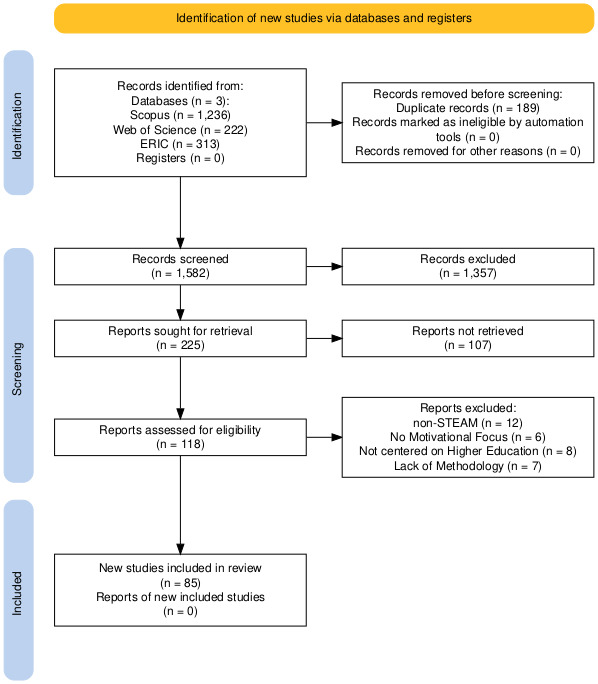
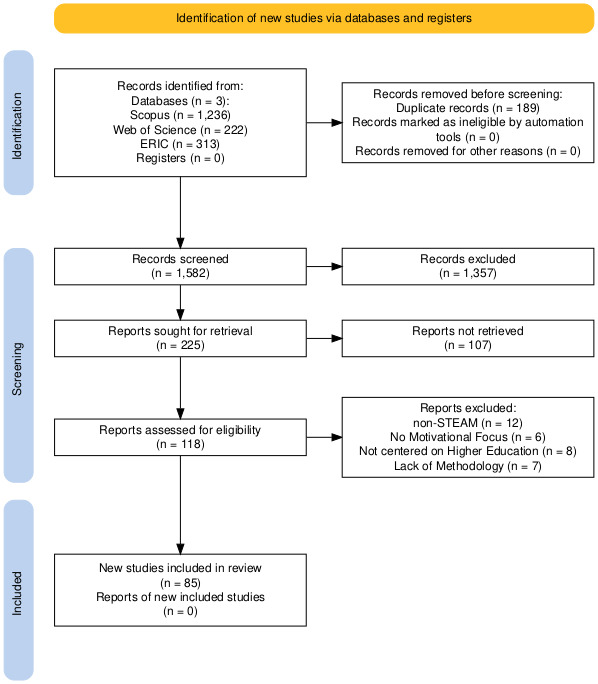
The systematic review focused on motivational theories and student engagement, yielding 1,771 initial records across Scopus, ERIC, and WoS, as illustrated in the PRISMA diagram (Figure 1). After removing 189 duplicates, title and abstract screening was conducted using ASReview (Van Dijk et al., 2023). This AI-powered platform was selected because, unlike alternative tools explored during our benchmarking phase (including Claude, Perplexity, SemanticScholar, ExplainPaper, Elicit, SciSpace, Consensus, PaperPal, and Scite), it is specifically designed for PRISMA integration through a researcher-in-the-loop approach. While those conversational LLMs and search engines lack transparency and do not allow user intervention, ASReview utilizes a machine learning model and generates a fully auditable trace of the selection process. Consequently, 1,357 records were excluded, leaving 225 candidates. Of these, 107 could not be retrieved, leaving a working set of 118 records. Subsequently, 33 were manually excluded due to a lack of relevance to motivation in STEM higher education, yielding a final sample of 85 studies.
By synthesizing the evidence from these publications through thematic synthesis, we identified six key factors that serve as the primary determinants for professional identity and motivation. This process involved iterative cycles of inductive and deductive coding, where data from the selected studies was categorized and compared to identify recurring patterns. Through successive rounds of refinement, we sought to ensure that these themes were grounded in the literature while providing an interpreted structure of the core dimensions found across the corpus. These factors then established the framework for the subsequent qualitative phase of our research.
To ensure the credibility of the thematic findings, a team of three researchers was actively involved in the qualitative coding phase. The process began with an initial calibration session, where a subset of the data was co-coded to align criteria and establish a common understanding of the codebook. Following this, the researchers independently coded the corpus using the six established factors as a deductive framework. Inter-coder agreement was checked through regular debriefing sessions; when disagreements occurred, they were resolved by consensus and collective deliberation rather than rigid statistical metrics. Regarding the potential circularity, the deductive framework served only as an initial guide. The subsequent inductive coding allowed new sub-themes to emerge directly from the participants’ discourse—such as specific emotional responses to GenAI and institutional resistance—which refined, and in some instances challenged, the boundaries of the original categories.
2.3. Qualitative phase
To address the second and third research questions (RQ2 and RQ3), we adopted a qualitative approach by conducting focus groups with students. These sessions included both students trained in pedagogy and peer tutors to capture a diverse range of perspectives on the academic experience. All sessions were recorded and transcribed to ensure the accuracy of the data. The information was then processed using thematic analysis through a hybrid coding process. We applied deductive coding based on the six factors previously identified in the scoping review, while also utilizing inductive coding to identify new themes emerging directly from the students’ discourse. This analysis allowed us to contrast theoretical frameworks with the lived reality of the students and provided the direct participant quotes (verbatims) used to support our findings.
3. Literature review and theoretical framework
3.1. From Individual Motivation to Institutional Engagement
To understand the mechanisms driving student persistence and professional identity, this study integrates several established frameworks. We first examine the psychological drivers of motivation and subsequently connect them to broader models of academic engagement.
3.1.1. Dimensions of Motivation: The Self-Determination Theory (SDT) Perspective
The core of our analysis is rooted in Self-Determination Theory (SDT) (Deci & Ryan, 2012), which posits that intrinsic motivation depends on the satisfaction of three basic psychological needs: autonomy, competence, and relatedness. To provide a more granular understanding, we link each of these pillars to complementary psychological frameworks.
-
Autonomy and the Future Self: Autonomy—the desire to be the author of one’s life—is deeply intertwined with a student’s belief in their own agency. Social Cognitive Theory (SCT) (Bandura, 1986) emphasizes self-efficacy as a primary predictor of whether a student feels autonomous enough to persist. This sense of agency is further shaped by Future Time Perspective (FTP) (Kooji et al., 2018), where a student’s vision of their future professional self regulates current learning. Finally, Dweck’s Mindset Theory (DMT) (1986) suggests that a growth mindset is essential for maintaining autonomy, as it allows students to view effort as a tool for change rather than a fixed limitation.
-
Competence and Goal Orientation: Competence involves the experience of mastery. This need is contextualized by Achievement Goal Theory (AGT) (Nicholls, 1989), which distinguishes between mastery goals (striving to learn) and performance goals (striving to outperform others). While both can lead to success, mastery is more closely linked to deep reflection (Struck Jannini et al., 2024; Struck Jannini & Menekse, 2023). Furthermore, Expectancy-Value Theory (EVT) (Wigfield & Eccles, 2000) explains that motivation for competence is a product of two factors: the student’s expectation of success and the subjective value—utilitarian or intrinsic—they assign to the task.
-
Relatedness and Sense of Belonging: Relatedness is the need to feel connected to others. Sense of Belonging Theory (SBT) (Baumeister & Leary, 1995) identifies this as a fundamental human drive requiring lasting, positive social exchanges. This connection has tangible academic outcomes: a strong sense of belonging improves accuracy and persistence (Walton et al., 2012), whereas its absence triggers anxiety and emotional exhaustion (Gere & MacDonald, 2010).
3.1.2. From Motivation to Academic Engagement and Retention
While SDT focuses on internal psychological needs, engagement models examine how these needs translate into institutional persistence.
Tinto’s Student Integration Model (SIM) (1975) serves as a foundational framework for this study, offering a longitudinal perspective on how student-institution alignment prevents attrition. Tinto posits that persistence is not merely an individual trait but a result of successful integration into both the academic and social systems of the university. Crucially, he frames dropout as a voluntary withdrawal that occurs when this integration is insufficient. This perspective is further corroborated by Astin’s Theory of Student Involvement (TSI) originally developed in the early 1980s (Astin, 2014), which operationalizes integration through the “quantity of physical and psychological energy” a student invests in their academic experience. Astin reinforces Tinto’s model by identifying faculty-student interaction and campus participation as primary drivers of involvement. However, he also introduces a cautionary nuance that aligns with our findings: excessive academic dedication, if not balanced with social connection, can lead to isolation—potentially undermining the very sense of relatedness that Tinto identifies as essential for long-term retention.
3.2. Identity and Maturity in Computing Education
The university period represents a critical transition where students don’t just acquire knowledge, but actively construct their professional identity. This process is influenced by biological maturity, social constructs, and the specific pedagogical design of the computing curriculum.
3.2.1. The Developmental Window: Personal and Epistemological Maturity
The transition into higher education coincides with a vital developmental milestone. While mental maturity typically peaks in the late twenties (Wood et al., 2018), the attainment of personal maturity has shifted from adolescence to the university years (Arnett, 2000). During this phase, students develop a “personal epistemology”—a framework for perceiving what constitutes knowledge and its limits within their field (Frezza et al., 2019; McDermott et al., 2013, 2015). This maturation is the foundation upon which professional identity is built (Wenger, 1999), moving the individual from a “student mindset” focused on passing to a “professional mindset” focused on expertise (Taylor-Smith et al., 2019).
3.2.2. Social Constructs and the Impact of Stereotypes
The decision to pursue and persist in computing is heavily mediated by social constructs rather than prior technical experience. The literature identifies two primary barriers:
-
Gender and Social Support: Enrollment often depends on a positive view of the field’s possibilities and social validation from family and peers, which is particularly critical for women facing entrenched gender biases (Charlesworth & Banaji, 2019; Sinclair & Kalvala, 2015).
-
The “Geek” Archetype: Computing is often perceived through the lens of stereotypes—viewing professionals as “asocial,” “lonely,” or “obsessive” (Taylor-Smith et al., 2019; Wong, 2016). These cultural narratives, combined with the reputation of the curriculum as “difficult” or “cerebral,” directly impact a student’s self-efficacy (Bandura, 1986). If students cannot visualize themselves succeeding within these stereotypical bounds, their motivation diminishes (Alshahrani et al., 2018).
3.2.3. Narratives of Belonging and Communities of Practice
Identity formation is a social process deeply rooted in Communities of Practice. Learning is not just cognitive; it is an act of “becoming” through participation in a community with shared goals (Lave & Wenger, 1991).
-
The Power of Belonging: A profound sense of community—feeling like “one of them”—is a primary driver for retention and innovation. This belonging is built through the negotiation of meaning in daily academic experiences (A. K. Peters et al., 2015; A.-K. Peters, 2019; Prawat, 1992).
-
The Delayed Narrative: In many computing curricula, the focus on abstract, basic training in early years delays the creation of these “stories of belonging” until the second or third year (Krause & Coates, 2008). This delay creates a disconnect, where students fail to see the relevance of their coursework to their future roles as “technical problem solvers” or “creators” (Kapoor & Gardner-McCune, 2018; A.-K. Peters, 2019).
3.2.4. Expectations vs. Academic Reality
Frustration often stems from the gap between initial expectations and the actual curriculum. Most new students identify as “entrepreneurs” or “developers” and expect to spend their time on creative, high-level tasks like AI or Robotics (Kapoor & Gardner-McCune, 2018). When the academic reality feels solitary or disconnected from these idealized goals, it can lead to burnout or dropout (A. K. Peters et al., 2014). Accelerating professional engagement requires a shift: integrating broader impacts—such as ethics and sustainability—into the early curriculum to foster a more holistic and resilient professional vision (Krause & Coates, 2008).
3.3. Instructional Design: Balancing Cognitive Demands and Institutional Barriers
Instructional design in computing must navigate the tension between the high cognitive complexity of the discipline and the need to foster a resilient professional identity. The literature suggests that motivation is not merely an emotional state, but a result of the balance between cognitive load, pedagogical format, and institutional culture.
3.3.1. Cognitive Architecture and the Flow State
The technical nature of computing requires a design that respects the student’s cognitive architecture.
-
Managing Load: Cognitive Load Theory (CLT) (Van Merrienboer & Sweller, 2005) posits that learning is optimized when “extraneous load” is minimized, allowing working memory to focus on the “intrinsic load” of complex problem-solving. Effective scaffolding and timely feedback are essential to reduce these motivational costs and maintain self-efficacy (Evans et al., 2024; Nadeem & Blumenstein, 2021; Shepard et al., 2018).
-
The Flow State: When the instructional challenge perfectly matches the student’s evolving skills, they may experience Flow (Csikszentmihalyi, 2014)—a state of deep absorption and enjoyment critical for persistence in demanding engineering tasks (Ngandu et al., 2023).
3.3.2. Methodologies: Active Engagement vs. Passive Alienation
The choice of pedagogical format significantly impacts how students perceive their competence and relevance. Environments such as Project-Based Learning (PBL), flipped classrooms, hands-on laboratories, and simulation-based learning foster academic achievement and a stronger professional self-concept (Koh et al., 2010; Winberg & Winberg, 2021). Tools like gamification can supplement engagement, but they only succeed if they support autonomy and mastery rather than exercising external control (Ngandu et al., 2023). These approaches are supported by practical frameworks like the ARCS and MUSIC models, which emphasize that attention, usefulness, and success must be intentionally designed into the curriculum (Jones, 2009; Nadeem & Blumenstein, 2021). Conversely, reliance on traditional lecture-heavy formats often leads to boredom and a sense of anonymity (Hauzel et al., 2024).
3.3.3. Institutional Barriers and Professional Persistence
Even well-designed instruction can be undermined by the broader institutional and social context.
-
Gatekeeping and “Weed-out” Cultures: The positive effects of autonomy—such as allowing choice in projects or using Contributing Student Pedagogies (Herman, 2012; Richardson, 2019)—are frequently negated by competitive “gatekeeping” pedagogies. Introductory courses with punitive grading systems increase anxiety and undermine competence beliefs, particularly in STEM (Gasiewski et al., 2012).
-
Future-Self and Belonging: Professional identity is strengthened when students see the utility value of their studies through industry interaction (Benson et al., 2016; Pantzos et al., 2023). However, this connection is fragile; social isolation, masculine stereotypes, and exclusion from lab cultures pose significant threats to the belonging and self-efficacy of women and minoritized groups (Mishkin, 2019; Wilson et al., 2015).
-
Culture of Wellbeing: Finally, addressing the normalized “culture of suffering” and high workloads is essential. Integrating reflection on wellbeing within the curriculum is necessary to manage stress and prevent the burnout common in computing disciplines (Spence et al., 2022).
3.4. Conditions designing the curriculum
Based on the literature review, the conditions that a curriculum should meet to promote a sense of belonging, professionalization, and identity include the following points:
-
Explicit Contextualization of Knowledge: Does the curriculum explain the relevance of basic subjects to the future professional career? The literature indicates that students often fail to see the utility of courses, leading to demotivation.
-
Early Development of “Stories of Belonging”: Are professional narratives introduced in the first year? Waiting until the second or third year to foster a sense of belonging allows feelings of isolation to take root.
-
Alignment of Expectations with Professional Reality: Does the program actively correct the misconception that computing is a solitary activity dedicated exclusively to programming? It must bridge the gap between the incoming student’s vision (solitary creation) and the reality (team-based problem solving). Does the curriculum promote effective teamwork?
-
Active Deconstruction of Stereotypes: Does the environment challenge stereotypes such as the “asocial genius”? Does it discuss the profession’s impact on society? Specifically, does the curriculum include ethics, sustainability, and social impact, particularly in the first year?
-
Facilitation of Social Integration (Relatedness): Does the design promote peer interaction and faculty-student connection to prevent isolation? Does the university environment offer facilities for social life beyond the classroom?
-
Promotion of a “Professional Mindset”: Does the assessment system foster learning for mastery (becoming an expert) rather than merely “passing” (performance goals)?
4. The Students Perspective
The literature review highlighted several themes to explore regarding the students’ perspective on their choice of degree, their expectations of computing studies, their view of the program, and how their perception of the profession evolves. While this bibliographic study was being conducted, four focus groups were held with students whose characteristics made them particularly interesting for this type of research. Specifically, we selected a convenience sample comprising peer tutors—due to their advanced academic perspective and mentoring experience—and students from a specific elective cohort, who possessed closer proximity to entering the professional industry. An experienced researcher moderated the sessions. While transcription utilized a generative AI tool subject to human verification, the subsequent data analysis was conducted exclusively by human researchers.
4.1. Peer tutors opinion
Our school offers first-year students a peer mentorship system to help them pass the first year, which is where the dropout rate is concentrated. This support system (called “Open Classroom”) consists of offering a grant to third- or fourth-year Computing Degree students to act as tutors for groups of first-year students, helping them understand subjects, organize themselves, or solve problems. Students may register for the open classroom sessions, attending for two hours weekly to clarify doubts, work on group exercises, or receive general guidance. With at least two support groups available for every first-year course, the initiative is highly valued by students, who report that it significantly aids their transition from secondary school to university. Peer tutors undergo training provided by a computing faculty member who is also an expert in engineering education. This training is conducted biannually, in September and February, immediately prior to the start of each semester.
Two focus groups were held during the training of two specific tutor cohorts, comprising the totality of students who attended the course. Each group consisted of 11 participants: the first included 9 males and 2 females, while the second included 8 males and 3 females.
4.2. Students with Pedagogical Training
The remaining two focus groups involved students enrolled in an elective course titled “Education, Engineering, and Technology.” This course was designed to provide Computing Engineering students with a grounding in pedagogical foundations, specifically tailored to engineering and technology contexts. The rationale is that creating educational content for tools (e.g., Docker), methodologies (e.g., DevOps), innovative technologies (e.g., IoT), or rapidly evolving fields (e.g., Cybersecurity) necessitates computing experts who not only master these subjects but also possess the skills to design effective educational activities for professionals.
This course provided a unique vantage point for our study. Since these students are in their final year and have spent a semester studying educational concepts—such as student motivation, professional identity, and teaching methodologies—their analysis of the curriculum’s strengths, weaknesses, and expectations was expected to be significantly more nuanced than that of other cohorts.
Two-hour sessions were conducted with two separate class groups in consecutive years, with 100% attendance from enrolled students. The first group consisted of 19 students (1 female, 18 males), and the second consisted of 20 students (6 females, 14 males).
5. Findings and Discussion
5.1. Findings
The information gathered reveals an insightful student cohort that is pragmatic yet frustrated. They value the “hard” skills (Linux, Projects, Problem Solving) but feel hindered by an archaic “Science-First” curriculum structure and a bureaucratic “Filter” culture.
The most significant finding is the proposal for “Curriculum Inversion”: Students explicitly requested that Engineering (Systems, Networks, Linux) be taught before abstract Science (Physics, Calculus) to provide necessary context and motivation.
The active methodologies commonly used in secondary education, to which students were accustomed, are largely lost at the university. They view this as a regression to passive learning based on lectures. Furthermore, they add that when these methodologies are employed, they are often implemented poorly. Some quotes from students belonging to the pedagogical formation group: “In high school we did more active stuff; here it’s just sitting down and listening to a lecture.”; Sometimes ‘flipped classroom’ is just watching a boring two-hour video and then going to class to solve problems with zero participation." “The way they implement new methods is often just a ‘face wash’ for the same old boring classes.”
A distinction was identified between the peer tutors group and the students in the education course, reflecting their different roles and analytical levels. While both groups reached a consensus on the core structural failings of the curriculum, their contributions offered distinct analytical layers. The Peer Tutors provided a ‘horizontal’ perspective, deeply rooted in the immediate emotional and social realities of their peers. Their data was particularly rich regarding Relatedness and the ‘Survival of the Fittest’ narrative, as they witness daily the ‘transition shock’ and the frustration of first-year students. In contrast, the Students in Computing Education provided a ‘meta-analytical’ viewpoint. Having been exposed to pedagogical theory, they were able to bridge the gap between their personal frustration and systemic causes. This group was significantly more vocal and precise regarding the ‘Explicit Contextualization of Knowledge’ and the regression in teaching methodologies. They didn’t just complain about ‘dry math’; they specifically identified the lack of a ‘mental scaffold’ and the poor implementation of active learning (like the flipped classroom). Including this group allowed us to move from identifying symptoms (Peer Tutors) to understanding pedagogical causes (Education students), significantly enriching the nuance of our findings.
Given that gender dynamics have been extensively studied in computing education, we considered it essential to observe whether any significant differences emerged in our findings. However, identifying the gender of each speaker during audio transcription was challenging; therefore, we relied on the facilitator’s detailed field notes to provide context. Consequently, these observations must be cautiously interpreted as a tentative hypothesis, as they do not rest on fully coded data. Specifically, female participants appeared to voice a stronger consensus regarding psychological pressure as a demotivating factor. While they did not explicitly attribute this pressure to their gender, they brought up the subject more frequently and expressed a higher level of concern. Despite this difference in thematic focus, which requires further validation due to our small, male-skewed sample, no evidence of a divide in perspectives was found when debates arose, suggesting a shared perception of the underlying academic and professional challenges.
5.2. Analysis
The following analysis summarizes the focus group findings, structured around the six previously defined pillars for motivating education. Each theme is supported by verbatim quotes from the participants before proceeding with the discussion (coded as ‘T’ for peer tutors and ‘E’ for education students). Care was taken during the translation of these quotes into English to preserve the level of formality and the intended meaning of the students’ original contributions.
1. Explicit Contextualization of Knowledge
Current State: The educational model relies on “just-in-case” learning.
Quotes: “We do physics, we do math, we do I don’t know what, but regarding computing itself, you barely touch anything until your third year.” (T); “I’m looking at this and saying, ‘well, I don’t even know what this is for’”(T); “They should introduce ‘Systems’ or ‘Networks’ in the first year to give us a mental map of what we’re doing; instead, they drown us in theory without any context.”(E); “It feels like the curriculum is backwards; you spend two years doing math proofs before you’re even allowed to see how a real computer works.” (E)
Analysis: Students feel they are learning abstract concepts (Physics, Math proofs) with little visibility regarding their relevance on why they matter until years later, or never. There is a strong consensus that the curriculum is out of sequence. Students suggest introducing Computing subjects in Year 1 to build a mental scaffold, then introducing the heavy math/physics later when the need for them is understood. Students feel like they are “not learning computing, but rather science,” due to the limited presence of computing-related content until nearly the third year.
2. Early Development of “Stories of Belonging”
Current State: A “survival of the fittest” narrative dominates the environment.
Quotes: “The mindset is that the first year is for weeding people out, and from the second year on, you actually start the degree.”(T); “The jump from high school to university is just too big.”(T); “At first, you feel totally lost, like you don’t know where to find anything or what you’re even supposed to do.”(T)
Analysis: There are two main points. First, the “Filter” Myth: The persistent narrative that Year 1 is designed to “fail you” or “weed people out” destroys the sense of belonging. It turns the institution into an antagonist rather than a mentor. Second, Transition Shock: The shift from the “Guided/Memorization” mode of High School to the “Independent/Understanding” mode of university is a chasm that many struggle to cross without better bridging mechanisms (like the suggested “Learning to Learn” module).
3. Alignment of Expectations with Professional Reality
Current State: A clear disconnect exists between exams and industry needs.
Quotes: “In the real world, you don’t write code that becomes useless just because a single dot is out of place.”(E); “The way exams are set up, you’re not learning to solve problems; you’re learning how to pass that specific test. It pushes you to find shortcuts or tricks just to get the ‘green light’ from the system, even if you don’t fully grasp the underlying logic.”(T); “When you finally get to a project where you’re building something real, like in the fourth-year electives, you don’t mind the extra work. You’re motivated because you’re actually doing what a computer expert does.”(E)
Analysis: Students love automated coding judges as a training tool (Mastery) but criticize it as an exam tool (Performance). In the real world (Professional Reality), software is developed iteratively with beta testing and debugging. In the exam, a single error can lead to fail. This misalignment causes anxiety and encourages “gaming the system” rather than learning. Furthermore, it is only in the 4th-year project subjects that they feel they are actually doing the job they signed up for. They are willing to work harder (Mastery) when the work resembles professional reality.
4. Active Deconstruction of Stereotypes
Current State: Students are transitioning from “hackers” to “engineers”.
Quotes: “I thought this was about being a ‘hacker,’ and then I realized it’s actually about administration and engineering.”(T); “The curriculum makes computing feel like just another branch of dry mathematics; you enter with the dream of building things, but the first two years almost kill that passion with nothing but theory.”(T); “They don’t show you the ‘cool’ side of the field until you’ve already spent years thinking that being a computer scientist is just solving integrals and abstract proofs on paper.” (E)
Analysis: Students enter with stereotypes derived from media (computing genius, “Hackers” in hoodies) or simple motivations (“Money,” “Work from Home”). Regarding the “Reality Check,” the focus group shows a maturation process. They realize that “hacking” is actually “system administration” and “engineering.” However, the curriculum often fails to capitalize on this by not showing the “cool stuff” (Cybersecurity, AI) early enough, leaving students stuck with dry theory that doesn’t combat the stereotype that Computing is just “boring math.”
5. Facilitation of Social Integration (Relatedness)
Current State: Bureaucracy, Assessment and GenAI act as main Barriers.
Quotes: “It feels like you’re just a number; you submit your work, get a grade back, and that’s it. There’s no personalized feedback to help you understand what you actually did wrong or how to improve.”(T); “Group projects are a mess because the grade is just for the final product, no one cares how the group actually worked.” (E); “If I have an AI that explains it better than the professor, why should I even bother coming to class?” (E)
Analysis: The difficulty of obtaining personalized feedback is considered one of the factors that undermines the sense of “belonging to the university” and acts as a structural barrier to interaction. It signals, “We don’t care if you learn from your mistakes.” The Mentorship program is a rare bright spot, cited as a crucial mechanism for navigating the initial chaos. Finally, while group projects are valued, the evaluation of them is contested; the perception that “Process” (how the group worked) is ignored in favor of “Product” (the final code) undermines the development of professional skills. Regarding absenteeism, students indicate that living off-campus and having to spend over two hours traveling to the university leads them to evaluate whether attending class is truly worthwhile. The emergence of GenAI tools allows them to analyze course documentation (notes, slides, etc.) to the extent that, unless the professor provides something truly significant, they prefer to study independently with the help of AI without coming to the university, thereby reducing opportunities for integration with their peers. Similarly, the rise of these tools has diminished the formation of traditional “study groups”.
6. Promotion of a “Professional Mindset” (Mastery vs Performance)
Current State: A performance-dominant culture defines the institution.
Quotes: “I just went there to pass exams… instead of actually learning.” (E); “A two-hour exam counts more than all the lab work you did during the entire semester.” (T); “We should be using AI like we will at work, as a tool to debug, but the system only cares if you ‘copied’ the result.”(E)
Analysis: Three points are highlighted. First, "Learning to Pass. The high-stakes assessment model forces students into a Performance Mindset (get the grade) rather than a Mastery Mindset (understand the concept). Second, Effort/Reward Imbalance: The low weighting for labor-intensive lab work signals that practical mastery is undervalued compared to theoretical exam performance. Third, AI as a Process Tool: Students are ready to use tools like ChatGPT professionally (as a co-pilot/debugger), but they feel the assessment system hasn’t caught up to evaluate the process of using AI, sticking instead solely to the product.
6. Summary and Future Directions
6.1. Summary
The work presented here is part of a broader institutional initiative funded by our university, referred to as Project PROPER. This project was launched in response to high dropout rates and low student satisfaction. The initiative aims to enhance students’ professionalization and their sense of belonging—both to the university and to the profession. The ultimate goal is to understand the needs of employers, society, and the students themselves to ensure that pursuing studies at our university is a motivating experience that helps each student define themselves both as a professional and as a person.
To deeply understand the challenges of attrition and engagement, this work executed a two-phased investigation. First, we established a consolidated theoretical baseline through a scoping review of motivation and identity in Computing. Second, we applied these concepts to evaluate the actual student journey, conducting a qualitative analysis that revealed how students’ initial expectations clash with their day-to-day experience. This diagnostic effort successfully isolates the critical areas where the current curriculum fails to foster professional identity, paving the way for targeted and effective educational reforms.
The findings of this study provide a structured response to our research questions, bridging the gap between theoretical expectations and reality. Regarding RQ1 (Key theoretical factors from literature), the thematic synthesis identified six primary determinants: contextualization, belonging, alignment with reality, deconstruction of stereotypes, social integration, and the promotion of a professional mindset. These factors provided the necessary framework to evaluate the current state of computing education through the eyes of its primary stakeholders.
In addressing RQ2 (Student perceptions), our findings reveal a significant tension between these theoretical factors and the actual academic environment. Students perceive a ‘performance-dominant’ culture where abstract theory and punitive assessment systems (such as automated judges) undermine their motivation and professional identity. The ‘Survival of the Fittest’ narrative and the lack of personalized feedback were identified as critical barriers that reinforce a sense of being ‘just a number’ rather than a developing engineer. Finally, concerning RQ3 (Suggested curricular changes), students explicitly advocate for a re-sequencing of the curriculum to include ‘mental scaffolds’ (like Systems or Networks) in the first year and a shift toward iterative, project-based learning that mirrors professional reality. These suggestions emphasize the need for the university to transition from a passive, lecture-based model to one that fosters a mastery-driven mindset and a genuine sense of belonging from day one.
6.2. Limitations of the study
Despite the insights gained, this study has some limitations that should be acknowledged. First, the sample size of the focus groups was relatively small and limited to a single institution, which may affect the generalizability of the results to other academic contexts. Additionally, the use of a convenience sample of peer tutors and an elective cohort introduces a self-selection bias, as participating students might possess higher motivation or distinct perceptions compared to the broader student population; this constraints the transferability of our findings to other settings. Furthermore, the sample was predominantly male-skewed, which limits our capacity to draw definitive conclusions regarding gender dynamics and restricts these observations to a tentative level. Second, while the hybrid coding process was rigorous, the qualitative nature of the analysis introduces a level of subjectivity in the interpretation of the themes. Finally, the study focuses on initial student perceptions; a longitudinal approach would be required to fully assess how professional identity evolves throughout the entire degree program.
6.3. Future work
The next step is to interview team leaders who interact with our alumni—ideally, leaders who are alumni themselves. These insights will help us identify the needs of graduates in the short term regarding specific technologies, as well as the long-term professional competencies required throughout a career.
Based on the findings from these initial phases, the project wants to propose a comprehensive action plan focused on three key areas: the redesign of curricula, the incorporation of microcredentials, and the provision of personalized support using AI.
First, we aim to redesign undergraduate and master’s curricula to better align them with employer needs and contextualize learning. This reconstruction allows for the creation of personal narratives of belonging that contribute to the development of students’ personal epistemologies.
Second, we are considering the incorporation of microcredentials to address rapidly evolving technologies. For example, the emergence of generative AI has led to a discussion on how to integrate these tools into core topics like programming. Since modifying the core curriculum is a complex process, a first step could be to create a specific course on this topic as a microcredential or elective credit. This ensures students perceive that the university is incorporating current concepts and practices related to the field.
Finally, recognizing the challenges of the transition from secondary school to university, we propose strengthening student support. Given the large number of students, purely human personalized support is difficult to scale. Therefore, the project aims to train artificial intelligence tools to provide high-quality guidance for common inquiries. This system would function alongside a “support center” staffed with trained personnel; the AI would handle routine interactions and escalate complex issues to human staff, ensuring a seamless experience. Although this pilot is taking place in a computing school, the entire process is being documented so it can be exported to other schools within our university.
Disclosure of Generative AI Use
In the scoping review process, ASReview V2.0 was utilized for the initial screening of articles, reducing the pool from 1552 retrieved papers to 225 eligible candidates. To cross-reference findings, the 89 final papers were processed using NotebookLM, facilitating rapid consultation of diverse perspectives on the subject.
The manuscript is entirely human-authored. Gemini Pro 3.0 was employed to assist with specific English translations, reduce the text length and, primarily, for grammatical verification and stylistic refinement.
Interview transcriptions were generated using TurboScribe (Whisper large model) and subsequently verified by a human researcher.
Funding
This work has been funded by the Universitat Politècnica de Catalunya through the Galàxia d’Aprenentatge project in its 2024 edition, and by the Facultat d’Informàtica de Barcelona.
Acknowledgement
We are grateful to the students who have participated in the focus groups.