1. Introduction
Generative artificial intelligence (GenAI) has transformed the landscape of education from early childhood and primary school (Ugras et al., 2024; Katsampoxaki-Hodgetts et al., 2025) all the way through higher education (e.g., Farrelly & Baker, 2023; Lo, 2023; McMurtie, 2023). Tools such as ChatGPT, Gemini, and Claude.AI can generate novel, human-like products such as text, images, and programming code in response to prompts. Instructors can leverage GenAI to help generate instructional materials, provide personalized feedback, and streamline administrative tasks, and students can use it to access explanations, problem-solving strategies, and debug code (e.g., Chiu, 2024). Through these applications, GenAI has the potential to enhance learning and improve learning efficiency in classroom settings.
However, GenAI technology is fundamentally probabilistic; it generates sequences of text based on patterns learned from massive training datasets (Mollick, 2024). This process allows GenAI tools to generate output that is creative and contextually relevant, but potentially inaccurate. Sometimes called “hallucinations” (but see Hicks et al., 2024), inaccuracies are inherent to GenAI responses, even in the current, cutting-edge GenAI models that implement chain-of-thought reasoning and retrieval augmented generation (e.g., Diamond, 2024; Hu et al., 2025; Lingard, 2023; Ray, 2023; Wei et al., 2022). Understanding this limitation is critical for users, especially in domains like engineering, where accuracy, precision, and assumptions are paramount.
Research has revealed that undergraduate students are more optimistic about GenAI tools than their instructors, and that levels of optimism are correlated with both adoption rates and frequency of use (Bego et al., 2024; Chan & Hu, 2023; Chan & Lee, 2023; Choudhury & Shamszare, 2023; Dietrich & Grassini, 2025). But students may not have a strong enough knowledge basis to evaluate GenAI output in order to fully understand its limitations, leading to overreliance and over-trust in GenAI output (Chan & Lee, 2023). It is therefore important to educate students on the limitations of GenAI, and to measure the effect of such interventions on attitudes towards GenAI and trust in its responses.
1.1. Trust in GenAI output
Trust is defined in this paper as the degree to which a person believes that a tool or information source will reliably provide accurate information. In this respect, trust is a fundamental component of adopting new technology such as GenAI (Wang, 2014). In a survey of over 1000 American undergraduate students, Baek, Tate, and Warschauer (2024) reported mixed adoption of ChatGPT for academic purposes. When probed further, some of the survey respondents expressed concerns about ChatGPT’s reliability and accuracy, particularly in fields where they perceived precision and accuracy to be critical. In another recent survey of American adults, trust in ChatGPT was predictive of intent to use it in the future and actual use (Choudhury & Shamszare, 2023). Spanish university students said being unable to judge whether AI is giving reliable answers is one of their biggest concerns about using it (Morell-Mengual et al., 2025). Thus, together with perceptions of usefulness, trust in the accuracy of ChatGPT can play a major role in its adoption.
Trust in any source may be high for some tasks and low for others, and recent work suggests that students’ trust in ChatGPT depends on the purpose of its use. In one study, the majority of British computer science students indicated that they did not trust information provided by ChatGPT in general (Bikanga Ada, 2024). Their qualitative responses suggested that although they were wary of ChatGPT’s ability to solve complex problems, they saw it as useful tool for simple tasks, such as summarizing lecture notes or paraphrasing.
There is also mixed evidence regarding whether trust in ChatGPT relates to education level. American students in a lower-level computer science course indicated more trust in AI systems than students in a higher-level course (Amoozadeh et al., 2023). Similarly, Chinese postgraduate students were more skeptical of the reliability of ChatGPT than undergraduate students (Xu et al., 2024). In contrast, postgraduate students in the UK showed greater trust in ChatGPT than their undergraduate counterparts (Bikanga Ada, 2024). These contrasting findings may reflect differences in measurement and in the type of experiences that students have had using GenAI, such as explicit training in its use.
1.2. Attitudes toward GenAI
Cognitive and affective attitudes towards GenAI have been linked to trust in and adoption of GenAI. Not surprisingly, university students who hold more positive attitudes toward GenAI are more likely to report intending to use it for academic purposes (Acosta-Enriquez et al., 2024). In a group of Swiss university students, Nazaretsky et al. (2025) found positive correlations between students’ perceived benefits of AI and perceived trust in AI educational technologies. There is also evidence that attitudes towards GenAI are largely independent of other personality traits and that younger adults have more positive attitudes towards GenAI than older adults (Stein et al., 2024).
Several groups of researchers have developed scales measuring attitudes towards AI in general (Acosta-Enriquez et al., 2024; Schepman & Rodway, 2020; Stein et al., 2024; Fietta et al., 2022; Grassini, 2023). These scales typically involve having participants indicate their degree of agreement or disagreement with statements about AI (e.g., “When I think about AI, I have mostly positive feelings”; Stein et al., 2024) and they sometimes include reverse-coded items (e.g., “I am afraid of AI”; Stein et al., 2024). For example, Schepman and Rodway (2020) asked non-student adults in the UK to express their agreement with positive and negative statements about AI using a 5-point Likert scale. They found that participants tended to hold a mix of positive and negative views of AI, and that comfort using AI was predictive of positive attitudes. Although the exact statements used for scales measuring attitudes towards AI vary, they frequently incorporate statements expressing excitement or hesitation about using AI as an individual and statements involving both positive and negative effects of AI on society.
Historically, attitude measures have been developed for other transformative technologies (e.g., computers, the internet; Durndell & Haag, 2002; Joyce & Kirakowski, 2015; Nickell & Pinto, 1986). Joyce and Kirakowski (2015) developed and validated a General Internet Attitudes Scale (GIAS) that included affect (negative feelings towards the internet), perceived social benefits and detriments (how the internet might be helping and/or harming society), and exhilaration (excitement using the internet). The authors found that, similar to recent studies on GenAI (Chan & Lee, 2023), age impacts attitudes; specifically, as age increases, internet attitude scores decrease (Joyce & Kirakowski, 2015). There are many similarities between attitudes towards previously novel technologies and GenAI, and many of the GenAI attitude scales are based on established and reliable attitude assessments.
1.3. Course experience, trust, and attitudes
Some recent studies have investigated GenAI interventions in engineering education and their effect on student perceptions and attitudes. For example, one introductory programming course was updated to include several assignments with GenAI, in which students were tasked with using AI tools to generate or explain code, explore concepts, or learn about some more advanced concepts like loops (Zviel-Girshin, 2024). Students’ familiarity with and use of AI tools significantly increased over the course of the semester, as well as their satisfaction with the tools. Similarly, Bernabai et al. (2023) found that Masters students in engineering demonstrated an increase in trust but also a greater sense of awareness of ChatGPT’s limitations after receiving instruction and completing an assignment using ChatGPT.
Although research in this area is nascent, early findings suggest that explicit instruction and structured practice using ChatGPT may affect student trust and attitudes—a possibility explored in the current study.
1.4. Current Study
The current study investigated the influence of ChatGPT integrations in a first-year introductory engineering course on student trust in ChatGPT outputs and attitudes towards ChatGPT. Students completed surveys before and after the course integrations. In the surveys, students judged the trustworthiness of ChatGPT to respond to engineering-application prompts and responded to questions about their general attitudes towards ChatGPT. There were two trust prompt categories: prompts for which a (1) correct or (2) incorrect response was likely to be generated. This study builds upon previously published research examining students’ trust and attitudes toward ChatGPT in first-year engineering students (Bego et al., 2024).
Our research questions were as follows:
RQ1: How do (a) ChatGPT integrations in a first-year engineering course and (b) prior experience with ChatGPT influence students’ trust in ChatGPT generating accurate responses to (c) different categories of prompts?
RQ2: How do (a) ChatGPT integrations in a first-year engineering course and (b) prior experience with ChatGPT influence students’ attitudes towards ChatGPT in general?
RQ3: Were student attitudes towards ChatGPT in general correlated with their trust in ChatGPT-generated information, before and/or after participating in the course’s ChatGPT integrations?
2. Methodology
This study was approved by the Institutional Review Board at the University of Louisville.
2.1. Participants
Participants (N = 288) were students enrolled in an introductory engineering course at the University of Louisville in Fall 2023 (class N = 481) who were not omitted from analyses for any of the following reasons: responses were missing for one or both surveys (N = 100); responses were missing for one or more questions within a survey (N = 62); a response indicated no experience with ChatGPT at the end of the semester despite course integrations (N = 6); responses had no variability across questions (N = 14); or an there was an unreasonable response on an attention-check question (N = 11).
2.2. Technology Context
In the Fall semester of 2023, OpenAI’s ChatGPT-3.5 was the most-popular, publicly-accessible and free version of GenAI. ChatGPT-3.5 could answer prompts with human-like verbiage and tone, write syntactically accurate python code, and describe standard textbook concepts well. It was limited in its ability to perform mathematical operations, obtain information beyond Fall 2021 which was used in its training dataset, and share source information, among other limitations.
Like modern versions of generative AI tools (ChatGPT-5.5, Google Gemini, and DeepSeek), the technology was probabilistic, generating output by evaluating a prompts’ meaning and context through tokenization and then predicting desirable response tokens based on patterns learned from its training set (Mollick, 2024). In a programming context, generative AI tools like ChatGPT are therefore very likely to produce syntactically correct code but require explicit prompting to produce code with unique formulas or logical structure.
2.3. Course Context
Engineering Methods, Tools, and Practice I is an introductory course taken by all engineering majors at the University of Louisville’s Speed School of Engineering in their first semester. It is a large enrollment course with nearly 500 students each Fall taught by a team of 3 instructors. Each instructor taught 2 sections of ~80 students. Instructors met weekly to review curriculum and used common materials and assignments across all course sections. The course introduced students to fundamental engineering topics including teamwork, critical thinking, ethics, programming, graphical drawing, and spreadsheets.
2.4. GenAI Course Integration
The purpose of integrating GenAI instruction and assignments into the course was to teach baseline GenAI literacy to all first-year engineering students. GenAI was introduced in week 5 of the course following a lecture on engineering ethics and professional engineering licensure requirements. To provide active and experiential learning, students were instructed to create or open a ChatGPT account and enter instructor-provided prompts. Creation of a ChatGPT account was encouraged but not enforced. Students were informed that interacting with ChatGPT was not private, and they should be careful sharing personal or private information. Instructor-provided prompts included (1) a large-digit multiplication problem and (2) a request for research on a topic with references, both of which revealed limitations of ChatGPT. Students were then instructed to validate ChatGPT’s responses with a calculator and Google search. The lesson demonstrated that ChatGPT could generate incorrect answers, and that even inaccurate responses may sound authoritative and look correct due to the technology’s strong language skills.
In addition to direct instruction about ChatGPT, guided uses of GenAI were incorporated into two team projects. The first project was a research report on one of the National Academy of Engineering’s Grand Challenges for Engineering (National Academy of Engineering, 2008). In class, instructors encouraged students to use ChatGPT to brainstorm some recent engineering solutions to an assigned challenge. Assignment instructions required students to verify all information provided by ChatGPT with additional external sources. In addition, students were instructed to cite the text or information generated by ChatGPT as a personal communication, which is cited only in-text.
The second project was a multi-phase application of vectors. ChatGPT was incorporated into the programming phase, in which students were responsible for creating a Python program to calculate the distance between two latitude and longitude coordinate points. Students were instructed to follow along with a code documentation worksheet that had them (a) plan the code, (b) use ChatGPT to write syntax, (c) review and modify their prompts if needed, (d) create test cases, and (e) evaluate the GenAI-generated code. Teams were required to turn in their programs as well as the code documentation file with details on the development and testing of the code.
2.5. Study Procedures and Materials
Students were invited to participate in optional surveys at the beginning of the class period in which ChatGPT was introduced (pre-survey, week 5 prior to GenAI in-class instruction) and on the last day of class (post-survey, week 15). The survey preamble described how participation in the survey conveyed consent to participate in the study. The surveys included questions about experience with ChatGPT, trust in ChatGPT output, general attitudes towards ChatGPT, and ethical opinions of ChatGPT. The ethical opinion questions are outside the scope of this paper.
Experience. The experience question was as follows: How much experience have you had interacting with ChatGPT? (a) None, (b) Minimal (I’ve tried it a few times), (c) Moderate (I’ve tried it several times with a purpose in mind), (d) Expert level (I’ve used it regularly for specific tasks). Because only a small number of students responded with choice (d) Expert, students who selected Moderate and Expert prior experience were grouped together for analysis, resulting in 3 experience categories: None (N = 86), Minimal (N = 114), and Moderate/Expert (N = 88).
Trust. There were 11 questions investigating student trust of ChatGPT output (see Table 1). These questions asked students to consider the likelihood that ChatGPT would produce a correct response to various prompts. Students did not interact with ChatGPT but simply indicated (on a scale from 1 to 100) whether they thought ChatGPT was likely to produce an accurate response to a particular prompt statement. Prompts were selected to vary across capabilities and limitations of ChatGPT at the time of this study (see Table 1).
A group of 7 researchers tested these prompts in ChatGPT-3.5 and each evaluated whether the generated answer was correct. Prompt history was cleared prior to each prompt. Prompts were then categorized as follows:
-
Correct response likely: prompts which returned a correct response 7 out of 7 times (5 items), and
-
Incorrect response likely: prompts which returned an incorrect response at least 3 times out of 7 (4 items).
There were two additional prompts that lacked specificity and could not be answered correctly without more information, specifically: “What was the exchange rate between the dollar and the euro in 2006?” and “What is the friction coefficient for sandpaper?”. In both cases, there could be a wide range of responses, as there were different exchange rates for different dates and times within 2006, and there are many different types of sandpaper with different friction coefficients. As responses to these two questions could not be categorized as correct or incorrect due to the lack of specificity in the question, student responses to these items were not included in this study.
Attention Check Question. The attention-check question asked students to evaluate the likelihood that ChatGPT could respond correctly to the prompt: “When did I wake up this morning?” Students with responses indicating high trust (>50% likelihood that ChatGPT would return a correct response) for this attention check question on the post-survey were excluded from the analysis.
General Attitudes. The measure of attitudes towards ChatGPT was adapted from the General Internet Attitude Scale (GIAS; Joyce & Kirakowski, 2015) by substituting the term “the internet” with “ChatGPT.” There were 21 items including general affect around ChatGPT (9 items; e.g., “I feel intimidated by ChatGPT”), perceived social benefits of ChatGPT (6 items; e.g., “ChatGPT makes a positive contribution towards society”), the perceived societal detriments of ChatGPT (3 items; e.g., “using ChatGPT is harmful to people”), and exhilaration while using ChatGPT (3 items; e.g., “using ChatGPT gives me a thrill”). Participants indicated their responses using a Likert scale with five response options: 1-strongly disagree, 2-slightly disagree, 3-no opinion, 4-slightly agree, and 5-strongly agree. All negative-leaning items were reverse coded, and then all responses were averaged to create a total (positive) attitude score.
The general attitudes measure showed very good internal reliability at both pre-test (Cronbach’s alpha = .917) and post-test (Cronbach’s alpha = .893).
2.6. Data Analysis Procedures
Survey data was exported from our course management system, combined across class sections, and coded to remove identifying information. An attitude and two trust scores (correct response likely and unlikely) were calculated by averaging the appropriate individual items. After filtering out incomplete and invalid data, Shapiro-Wilk tests were conducted to assess normality of the dependent variables. Attitude scores were normally distributed, but trust scores were significantly negatively skewed. Because the trust values had meaning (e.g., how likely students thought that ChatGPT would respond correctly, out of 100 percent), and because the following analyses are robust to normality deviations, the data were not transformed.
Two mixed-factorial analyses of variance (ANOVAs) with post-hoc comparisons were conducted, applying a Bonferroni correction. The first ANOVA examined participants’ trust in ChatGPT’s ability to give accurate responses; within-subjects factors were trust prompt category (2 categories: Correct Response Likely, Incorrect Response Likely) and time (2 timepoints: pre- and post-course integrations) and a between-subjects factor was prior experience (3 levels: none, minimal, moderate/expert). The second ANOVA examined participant attitudes towards ChatGPT before and after the course integrations with a within-subjects factor of time (2 timepoints: pre- and post-course integrations) and between-subjects variable of prior experience (3 levels: none, minimal, moderate/expert).
Lastly, correlations were conducted to evaluate the relationship between student attitudes towards ChatGPT (pre- and post-course integrations) and trust in ChatGPT output (Correct Response Likely and Incorrect Response Likely categories, also at the pre- and post-integration timepoints).
3. Results
This study evaluated the impact of a set of course integrations on first year engineering students’ trust in ChatGPT output and general attitudes towards ChatGPT, with additional factors of trust prompt category and prior experience.
3.1. Trust
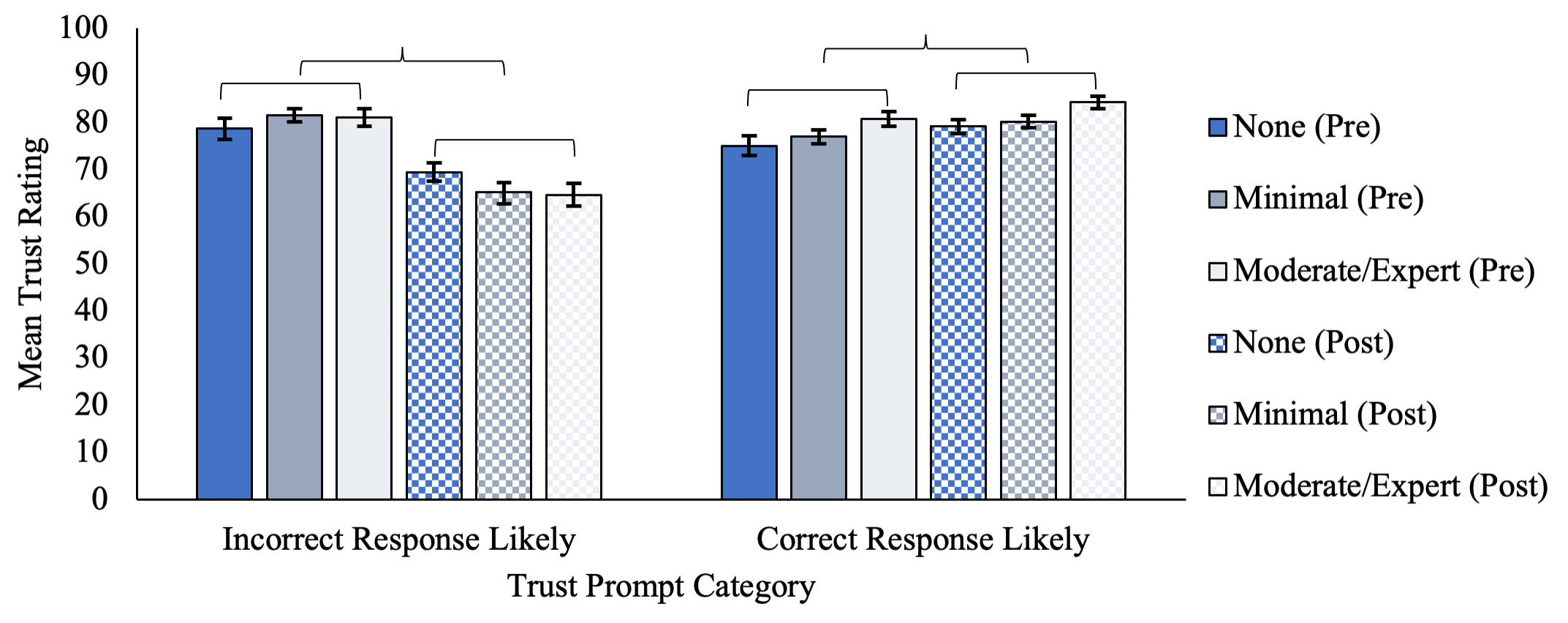
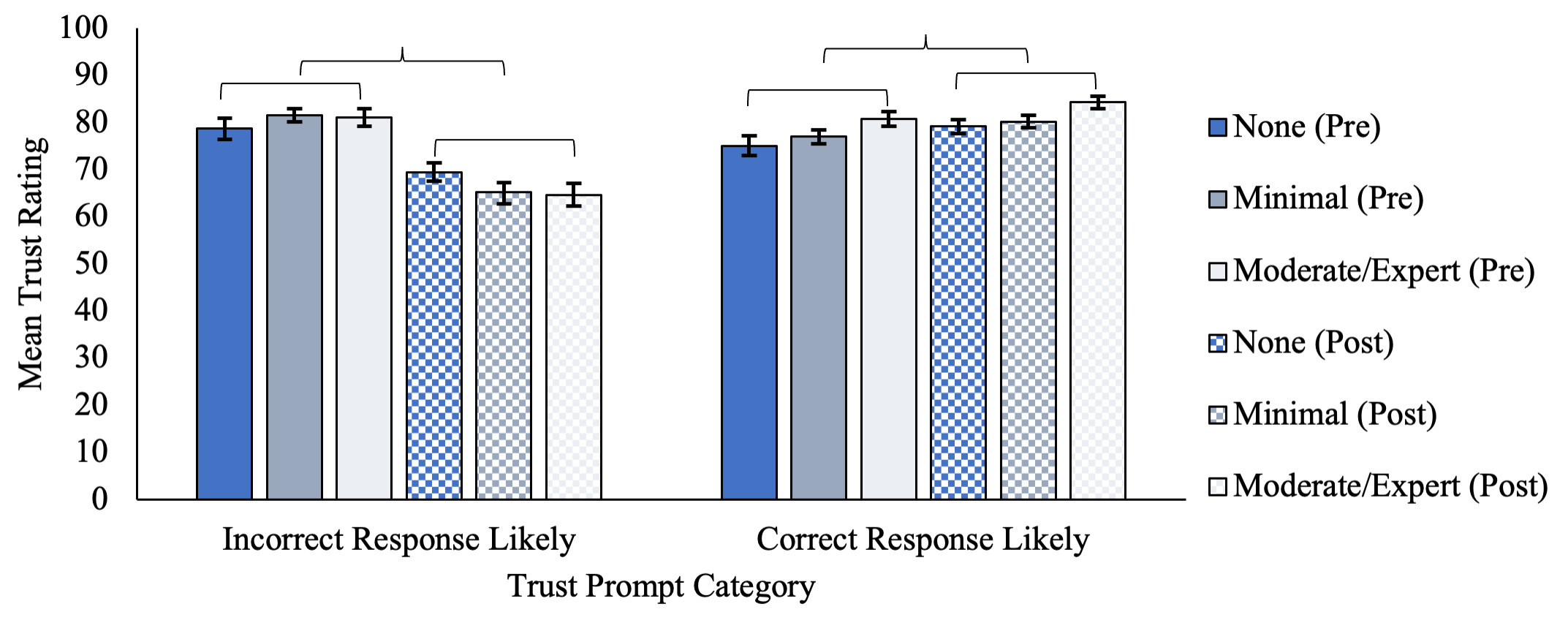
The ANOVA examining student trust outcomes with factors of trust prompt category (2 levels: Correct Response Likely, Incorrect Response Likely), time (2 levels: pre- and post-course integrations), and prior experience (3 levels: none, minimal, moderate/expert) revealed significant main effects of trust prompt category and time, but there were also significant interactions between trust prompt category and time, F(2, 285) = 191.69, p < .001, ηp2 = .402, and between trust prompt category and prior experience, F(2, 285) = 6.97, p = .001, ηp2 = .047. The three-way interaction was not significant (p = .064). The interaction between trust prompt category and time was driven by a decrease in trust ratings in the Incorrect Response Likely category (p < .001) and an increase in trust ratings in the Correct Response Likely category (p = .004) at the end of the semester (see Figure 1). The interaction between trust prompt category and prior experience was driven by the differences between trust prompt categories within prior experience groups, with significantly higher ratings for the Correct Response Likely category than the Incorrect Response Likely category in the minimal and moderate/expert experience groups (p < .001), but not for the no prior experience group (p = .253).
3.2. Attitudes
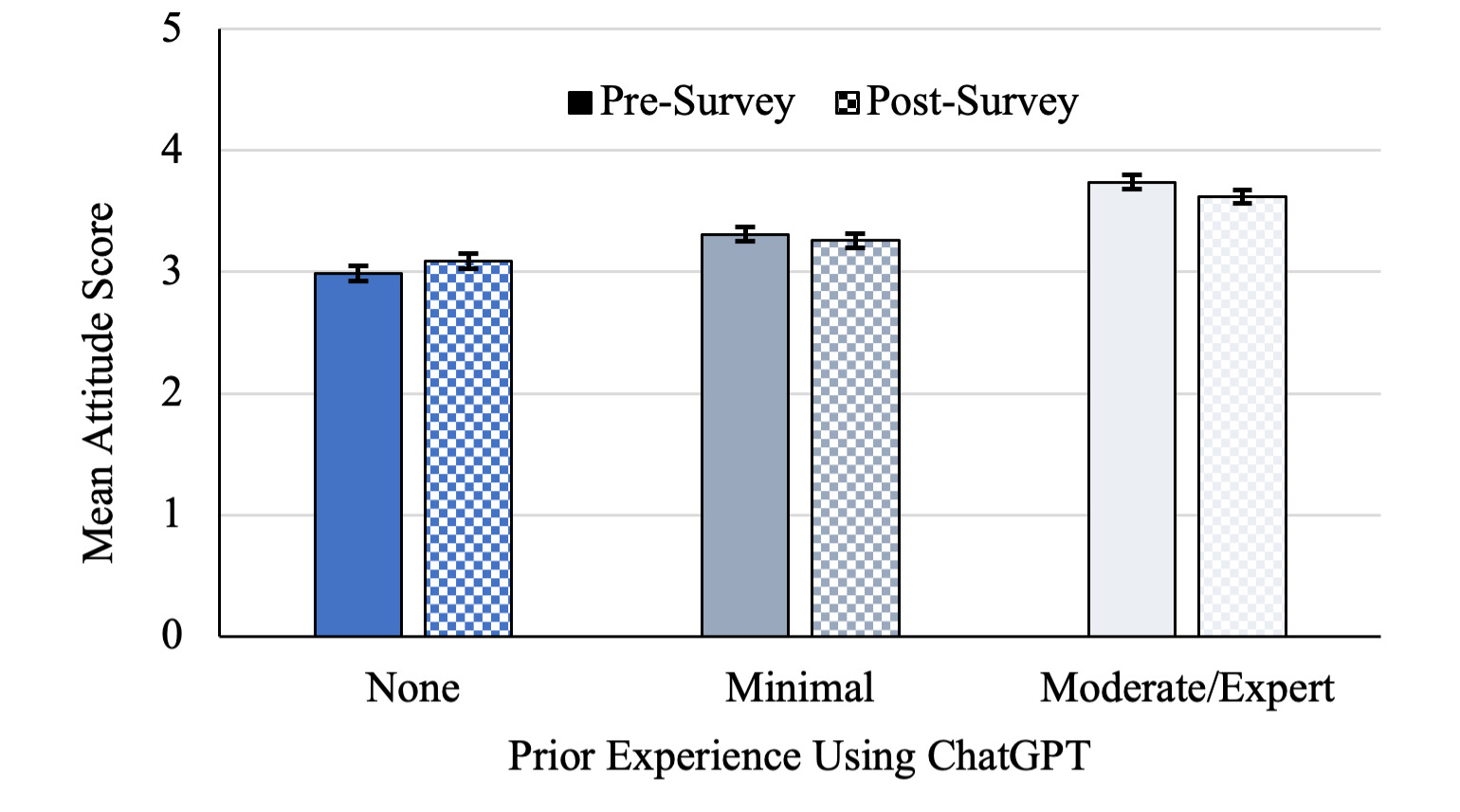
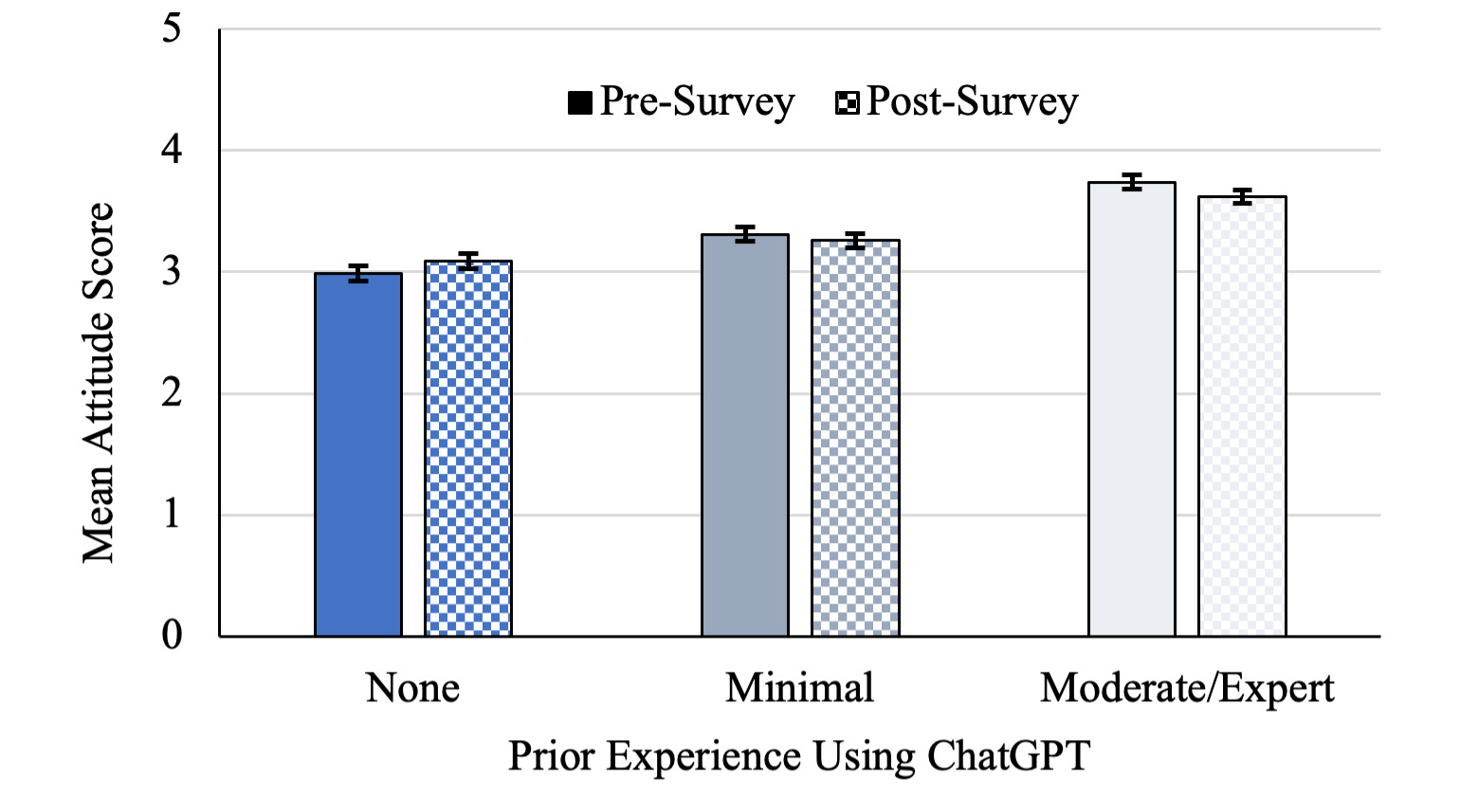
The ANOVA examining student attitudes towards ChatGPT with factors of time (2 levels: pre- and post-course integrations) and prior experience (3 levels: none, minimal, moderate/ expert) showed a significant main effect of prior experience, but also a significant interaction between time and prior experience, F(2, 285) = 5.017, p = .007, ηp² = .034. Post-hoc comparisons showed that in the pre-survey, students with greater prior experience with ChatGPT had more positive attitudes (i.e. each experience group significantly differed from the others, p <= .003), but in the post-survey (after all students had some experience using ChatGPT through course activities and assignments), the none and minimal experience groups no longer differed from each other (p = .665, see Figure 2). Student attitudes within each experience group did not differ significantly from the pre- to post-survey.
3.3. The Relationship between Attitudes and Trust
Before the course integrations, students’ general attitudes towards ChatGPT were significantly positively correlated with trust scores for both trust prompt categories (Correct Response Likely: r = 0.197, p < .001 and Incorrect Response Likely: r = 0.126, p = .033, see Table 2). After the course integrations, students’ general attitudes were still significantly positively correlated with trust scores for the Correct Response Likely items (r = 0.164, p = .005) but they were no longer significantly correlated with trust scores for the Incorrect Response Likely items (r = 0.070, p = .239).
4. Discussion
This study investigated first-year engineering students’ perceptions of ChatGPT before and after course-guided experiences using ChatGPT. Survey questions included trust judgments about ChatGPT output (assessed with questions asking students to predict the likelihood of ChatGPT producing correct or incorrect responses for various prompts), attitudes towards ChatGPT (the extent to which they feel positively about ChatGPT use and its impact on society) and prior experience with ChatGPT.
Experience with ChatGPT, both in and out of the classroom, appeared to play a large role in shaping students’ trust judgments. Students who reported greater experience with ChatGPT in the pre-survey tended to express higher trust levels in ChatGPT from the outset. However, classroom experience also mattered: at the end of the course, students improved in their ability to differentiate between prompts that were likely to yield correct responses from ChatGPT versus likely to yield incorrect responses. Across all prior experience levels (none, minimal, and moderate/expert), students exhibited a significant decrease in trust ratings over time for prompts where incorrect responses were likely. Additionally, their trust significantly increased for prompts for which correct responses were likely. The overall effect size was large (ηp² = .42; Richardson, 2011), indicating that the integrations had a strong impact on students’ trust judgements.
The improvement in trust judgements suggests that students came to understand some of the capabilities and limitations of GenAI technology through the course integrations. The course integrations in this study were intentionally designed to highlight strengths of GenAI as a tool for learning (for example brainstorming or getting started learning about a topic) while also emphasizing its potential for generating inaccurate information. These interventions were similar to previous research that had engineering students test the breadth of possibilities with ChatGPT for writing assignments, revealing limitations of ChatGPT and resulting in both improved adoptive attitudes and awareness of limitations (Bernabei et al., 2023). In our introductory GenAI lesson, students were instructed to write prompts that revealed ChatGPT failures (i.e. inaccurate responses). Though trust in ChatGPT remained relatively high overall, these activities appeared to help students recognize the increased potential for inaccuracies in certain types of prompts. Given the increasing prevalence of GenAI tools in education and professional settings, such differentiation between capabilities and limitations represents a critical component of GenAI literacy (Bego et al., 2024; Sullivan et al., 2024).
The course integration did not appear to have the same amount of influence on students’ general attitudes towards ChatGPT as it did on trust in ChatGPT responses. Prior to the course integrations, there were significant attitude differences between all prior experience levels in the pre-survey (students with more self-reported prior experience generally had more positive attitudes toward ChatGPT), providing another datapoint supporting the idea that attitudes drive adoption (e.g., Acosta-Enriquez et al., 2024). However, attitudes did not significantly change over time for any group. It is possible that general attitudes towards ChatGPT (affect, reflections on social benefit and detriment, and exhilaration) are more stable and trait-like than trust judgements. However, it is worth mentioning that the goal of our course integration was not to shift attitudes more positive or negative towards GenAI. In fact, the integrations were designed to reveal both strengths and weaknesses of the new technology. Although instructors spent a good amount of time demonstrating the limitations with respect to accuracy, they also revealed its strengths in technical and syntax writing through the selected assignment integrations. The fact that ChatGPT was integrated into the course—instead of forbidden—was demonstratively supportive. Nevertheless, our results show that experiences in the course did not meaningfully change students’ attitudes towards ChatGPT.
There were positive correlations between students’ general attitudes toward ChatGPT and their trust ratings on both pre- and post-surveys. However, post-integration, attitudes remained positively correlated only with trust in Correct Response Likely prompts, and no longer with trust in Incorrect Response Likely prompts. This suggests that while students maintained their overall perceptions of GenAI, they became more discerning in their trust judgements.
Our findings underscore the importance of in-class experiences with GenAI tools. Exposure to structured course integrations allowed students to develop a more accurate understanding of ChatGPT’s capabilities and limitations than individual experiences. Activities demonstrating GenAI failures and practicing verification can influence student discernment in trust of GenAI output. This aligns with broader research emphasizing the importance of GenAI literacy enhancement efforts (Bego et al., 2024; Sullivan et al., 2024).
4.1. Limitations
This study was conducted at one institution and at one point in time. Our findings may therefore be limited to broader contexts or other educational settings. GenAI capabilities are advancing and prompt categorizations in this study are specific to the model evaluated. However, these results offer a focused view that highlights significant shifts in student trust judgments due to course adaptations—work that needs to be undertaken in many first-year engineering programs. It is possible to create assignments that reveal strengths and weaknesses of current GenAI tools, and our results indicate that this is a worthwhile endeavor.
One other limitation is that our survey did not cover the full spectrum of GenAI literacy. For example, we did not consider elements such as competence using GenAI tools and ethical decision-making. However, these results provide valuable insights into how students can be taught to discern and evaluate the reliability of GenAI output. This targeted approach, and other future work on additional GenAI literacy outcomes, will have broader implications for higher education.
5. Conclusions and Future Work
This research revealed that applied, course-based integrations of ChatGPT within a first-year engineering course improved students’ differentiation in trust judgements for ChatGPT capabilities and limitations without changing their general attitude towards the technology. These results are promising in a world where GenAI literacy skills are increasingly necessary in both academic and professional settings. Future work will consider additional student learning outcomes alongside the integration of GenAI including programming competencies and other GenAI literacy components like ethical awareness and competence. However, current findings indicate that discipline-specific assignments and experiences can facilitate learning about GenAI. Teachers should embrace the transformation of the educational landscape and identify course-specific opportunities for integration.
Author contributions
Campbell R. Bego: Conceptualization, Data Curation, Formal Analysis, Investigation, Methodology, Project Administration, Visualization, Writing – Original Draft Preparation, Writing – Reviewing and Editing
Angela K. Thompson: Conceptualization, Investigation, Methodology, Visualization, Writing – Original Draft Preparation, Writing – Reviewing and Editing
Judith H. Danovitch: Conceptualization, Formal Analysis, Methodology, Visualization, Writing – Original Draft Preparation, Writing – Reviewing and Editing
Travis Hicks: Formal Analysis, Visualization, Writing – Original Draft Preparation, Writing – Reviewing and Editing
Availability of Data and Materials
A comprehensive list of survey questions is included in supplemental resources. The datasets generated and analyzed are available in an Open Science Framework repository (https://osf.io/wyge8/files/osfstorage). Instructional materials and assignments will be shared upon request from the corresponding author.
Competing interests
There were no competing interests for this work.
Funding
There was no funding for this work.
Acknowledgements
There are no acknowledgements for this work.
Statement on AI Use
AI was not used in the creation of this manuscript.