1. Introduction
Mathematical modeling, the art of constructing, analyzing, and validating mathematical representations of real-world phenomena, is an indispensable competency in the education of future engineers, as computational modeling serves as the backbone of modern engineering design, simulation, and optimization (Sun et al., 2023). It serves as the critical nexus where abstract mathematical theory converges with complex, ill-structured engineering problems—from mechanical structure optimization to electrical system simulation. The ability to navigate this nexus—to formulate an engineering problem, select and implement an appropriate model, interpret results critically, and communicate findings effectively—is a hallmark of sophisticated quantitative reasoning for engineering professionals (Boaler, 2022; Laursen & Rasmussen, 2019).
Despite its acknowledged importance, a significant disconnect persists between the pedagogical approaches of traditional university-level mathematical modeling courses and the dynamic realities of modern data-intensive fields (Baumer & Ben, 2015; Dogucu et al., 2025). A tripartite challenge characterizes this disconnect. Firstly, there is a profound toolchain misalignment. For decades, curricula have been heavily reliant on commercial, domain-specific software platforms like MATLAB and Mathematica (Albakri et al., 2024; Paci et al., 2024). While powerful for specific numerical computations, these tools often function as “black boxes,” obscuring the underlying mathematical and computational processes from students (Ali & Nath, 2023). This stands in stark contrast to the open-source, Python-dominated ecosystem that has become the lingua franca of data science, artificial intelligence, and scientific research (Harris et al., 2020; McKinney, 2022). This misalignment risks rendering graduates’ skills obsolete and limits their computational agility and flexibility in a rapidly evolving technological landscape (Bond et al., 2023).
Secondly, the authenticity of problems and data is severely constrained. Traditional teaching cases are typically highly simplified, pre-cleaned, and idealized (Noll et al., 2023). While pedagogically convenient, this sanitization deprives students of the crucial, and often most time-consuming, phases of the modeling lifecycle: data acquisition, cleaning, wrangling, and feature engineering. Consequently, students fail to develop essential “data sense” and the resilience needed to handle the noisy, incomplete, and complex datasets that characterize real-world applications. This creates an artificial chasm between sterile academic exercises and the iterative, non-linear nature of professional modeling work (Donoho, 2017).
Finally, the prevailing pedagogical model often remains passive and individualistic. The traditional teacher-centered paradigm, where students mimic pre-defined experiments in isolated computer lab settings, provides scant opportunity for collaborative problem-framing, critical discourse, or peer feedback (Holtz et al., 2018; Ifenthaler & Schumacher, 2023). This model is ill-suited for cultivating the collaborative, communicative, and metacognitive skills that are hallmarks of both modern scientific inquiry and high-quality mathematical modeling (Larmer et al., 2020; Zhang et al., 2024). It fails to prepare students for the interdisciplinary teamwork required to address the complex, systemic challenges of our time (National Academies of Sciences, Engineering, and Medicine, 2018).
In response to these challenges, educational reformers and researchers have advocated for pedagogical shifts grounded in constructivist and social learning theories. Project-Based Learning (PBL) has emerged as a powerful framework, engaging students in sustained, collaborative inquiry around complex, authentic questions, thereby fostering deeper conceptual understanding and transferable skills (Guo et al., 2020; Kokotsaki et al., 2016; Larmer et al., 2020). Concurrently, the Python programming language has ascended as the platform of choice for scientific computing, offering a transparent, versatile, and widely supported environment for mathematical exploration (Harris et al., 2020; Van Rossum & Drake, 2014). Its rich ecosystem of libraries (e.g., NumPy for numerical computation, Pandas for data wrangling, Scikit-learn for machine learning) allows students to interact directly and intuitively with mathematical objects and processes (Buitinck et al., 2013; McKinney, 2022).
The advent of cloud-based collaborative platforms like Google Colab and Jupyter Notebooks has further removed traditional barriers to entry, offering zero-configuration environments with scalable computational resources (Bond et al., 2023; Locus IT Services Nordic, 2025). More importantly, these platforms natively support real-time collaboration and literate programming, making them an ideal technological infrastructure for the social constructivist learning that PBL promotes (Fang et al., 2025; Kovanović et al., 2016). They facilitate the co-creation of knowledge and mirror the distributed, collaborative, and reproducible workflows of contemporary technical teams (Talajić et al., 2025).
While PBL, Python, and cloud platforms have been explored separately in STEM education, a critical gap remains in the literature. There is a scarcity of controlled, empirical studies that quantitatively measure the efficacy of a deeply integrated framework that weaves these elements together into a coherent whole, specifically within a mathematical modeling context, and evaluates it against traditional methods using robust, objective metrics of mathematical learning (Ismael et al., 2024). Many existing publications are descriptive case studies that, while valuable, lack the comparative rigor to make definitive claims about learning outcomes.
This study is designed to address this gap by conducting a rigorous, quasi-experimental evaluation of a comprehensively reformed mathematical modeling lab course. The reform is instantiated through a novel four-layer pedagogical framework (Tool, Methodology, Practice, Assessment) that systematically integrates a Python/cloud toolchain with a scaffolded PBL methodology. Our investigation is guided by the following research questions:
-
Does the integrated Python and cloud-based PBL framework lead to a greater improvement in mathematical modeling proficiency, as measured by standardized assessments and project work, than a traditional MATLAB-based curriculum?
-
What are the students’ experiences and perceived learning gains within the experimental framework, particularly regarding their conceptual understanding of mathematics?
By answering these questions, this study aims to provide an empirically validated and replicable model for modernizing STEM education, with significant implications for curriculum designers and educators.
2. Methodology
2.1. Research Design
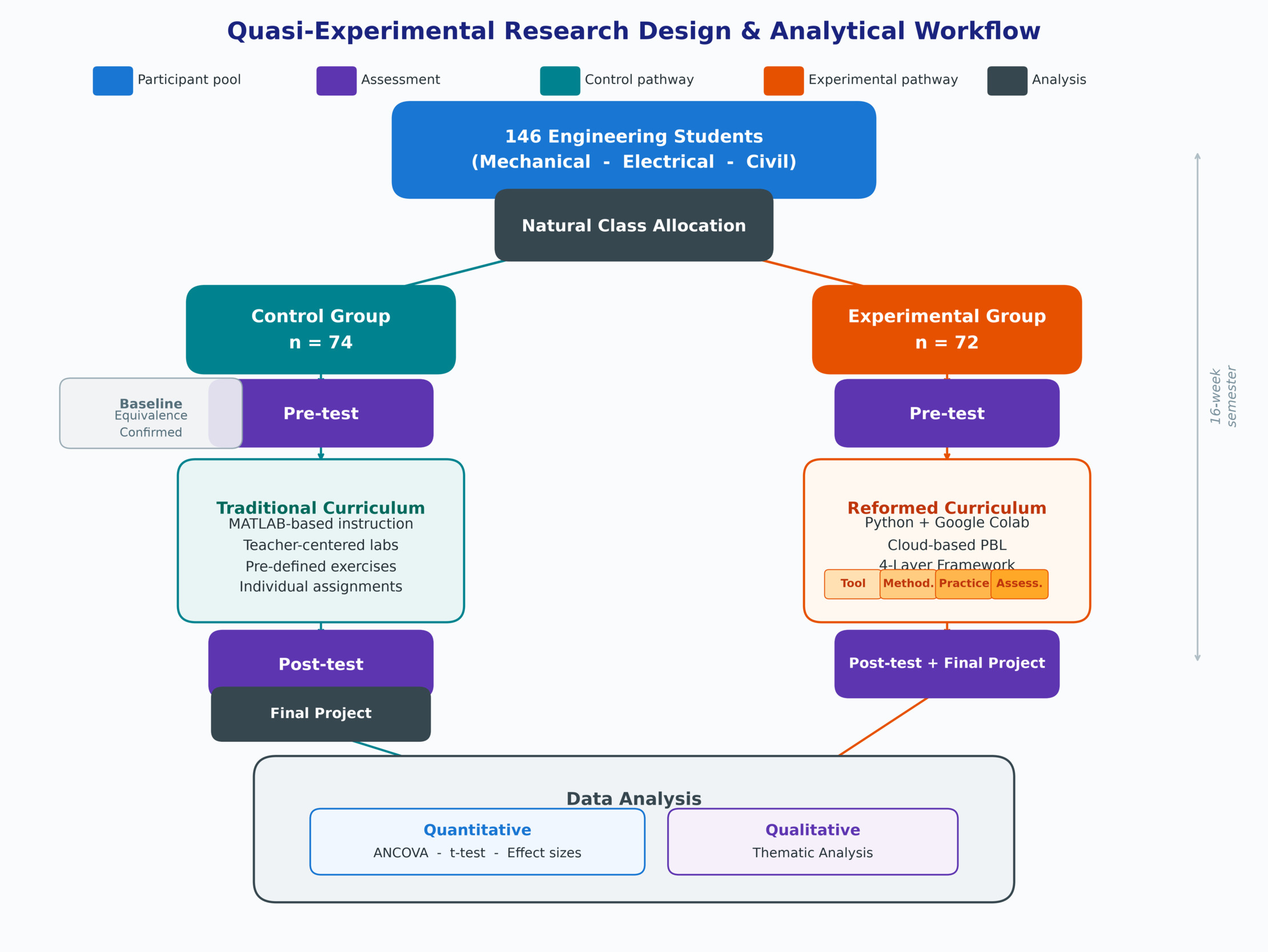
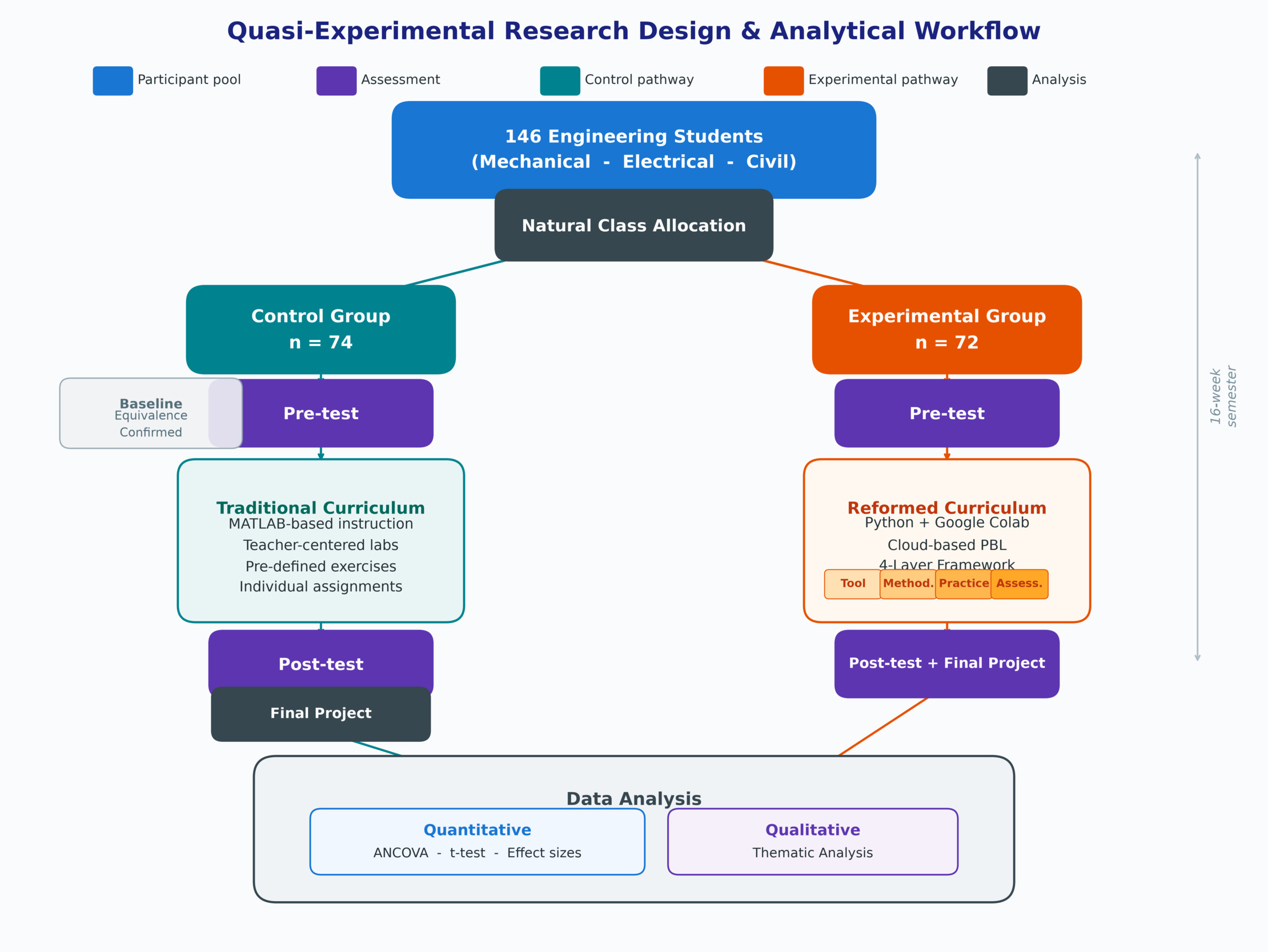
To robustly evaluate the impact of the curricular reform, a quasi-experimental, pre-test/post-test control group design was implemented. This design was selected for its strength in establishing causality in settings where random assignment of individual participants is logistically challenging, such as in intact university courses (Creswell & Creswell, 2023). The design allows for the comparison of learning outcomes between two naturally occurring groups undergoing different instructional interventions while controlling for baseline proficiency. The flow of the study, from participant allocation through data analysis, is detailed in Figure 1.
2.2. Participants and Context
The study was conducted in a compulsory “Mathematical Modeling Lab” course for second-year undergraduate students across various engineering disciplines (Mechanical, Electrical, and Civil) at a major public university in China. A total of 146 students participated. The participants were enrolled in two separate sections of the course, which were naturally assigned as the Experimental Group (n=72) and the Control Group (n=74). This allocation was based on the students’ pre-existing class schedules, a common practice in quasi-experimental educational research. To ensure the groups were comparable at the outset, we collected and analyzed key demographic and academic variables. As summarized in Table 1, independent samples t-tests and chi-square analyses confirmed that there were no statistically significant differences between the groups in terms of age, gender distribution, prior academic performance (GPA), or, most critically, their pre-test mathematical modeling scores. This baseline equivalence strengthens the validity of subsequent comparisons. Furthermore, a post-hoc power analysis was conducted using G*Power 3.1. With the obtained sample size (N=146), an significance level of .05, and the observed effect size for the primary ANCOVA (η₂² = 0.15), the achieved statistical power exceeded 0.99, indicating that the study was sufficiently powered to detect a large effect.
2.3. Intervention: The Four-Layer Pedagogical Framework with Mathematical Foundations
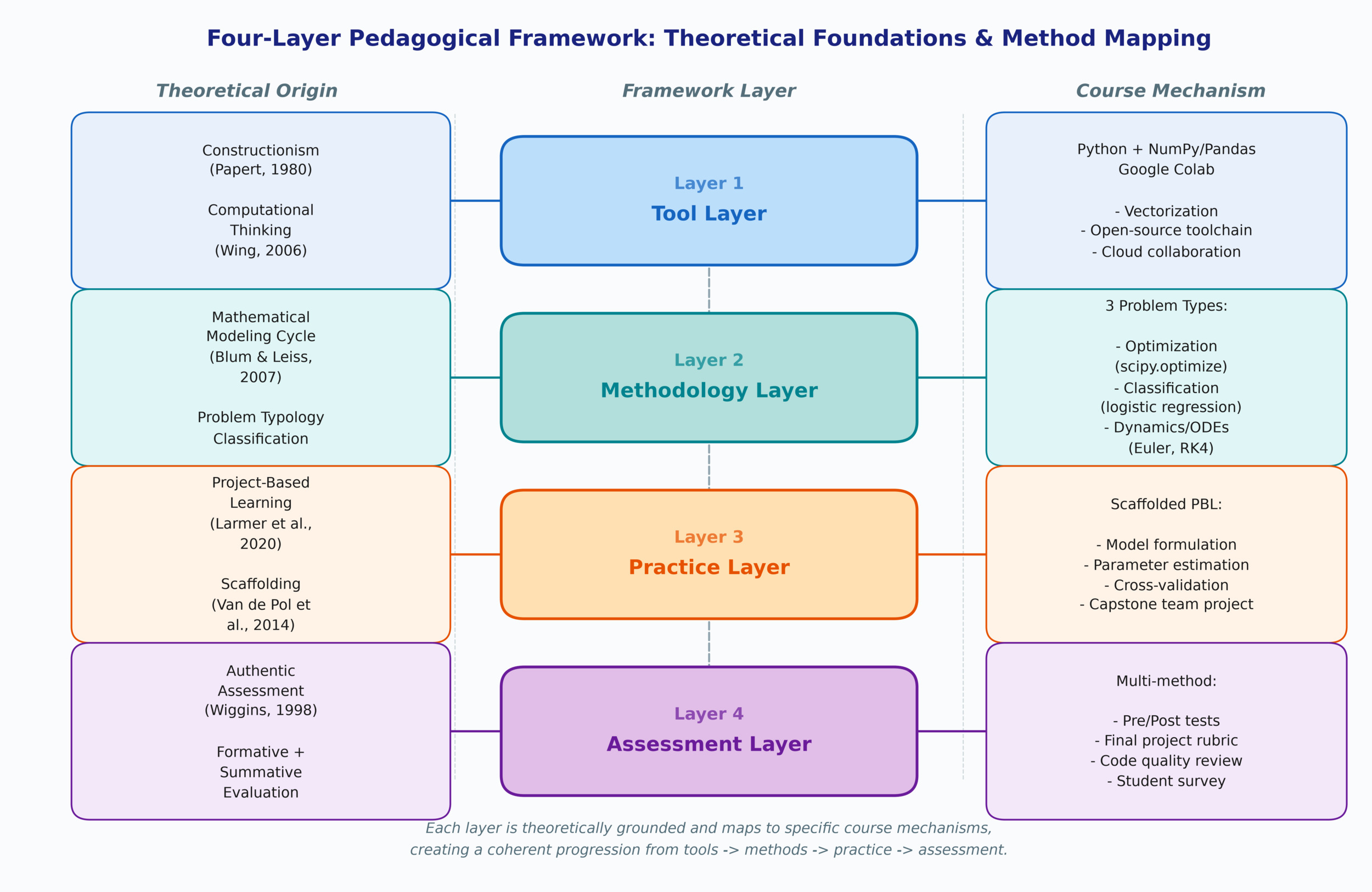
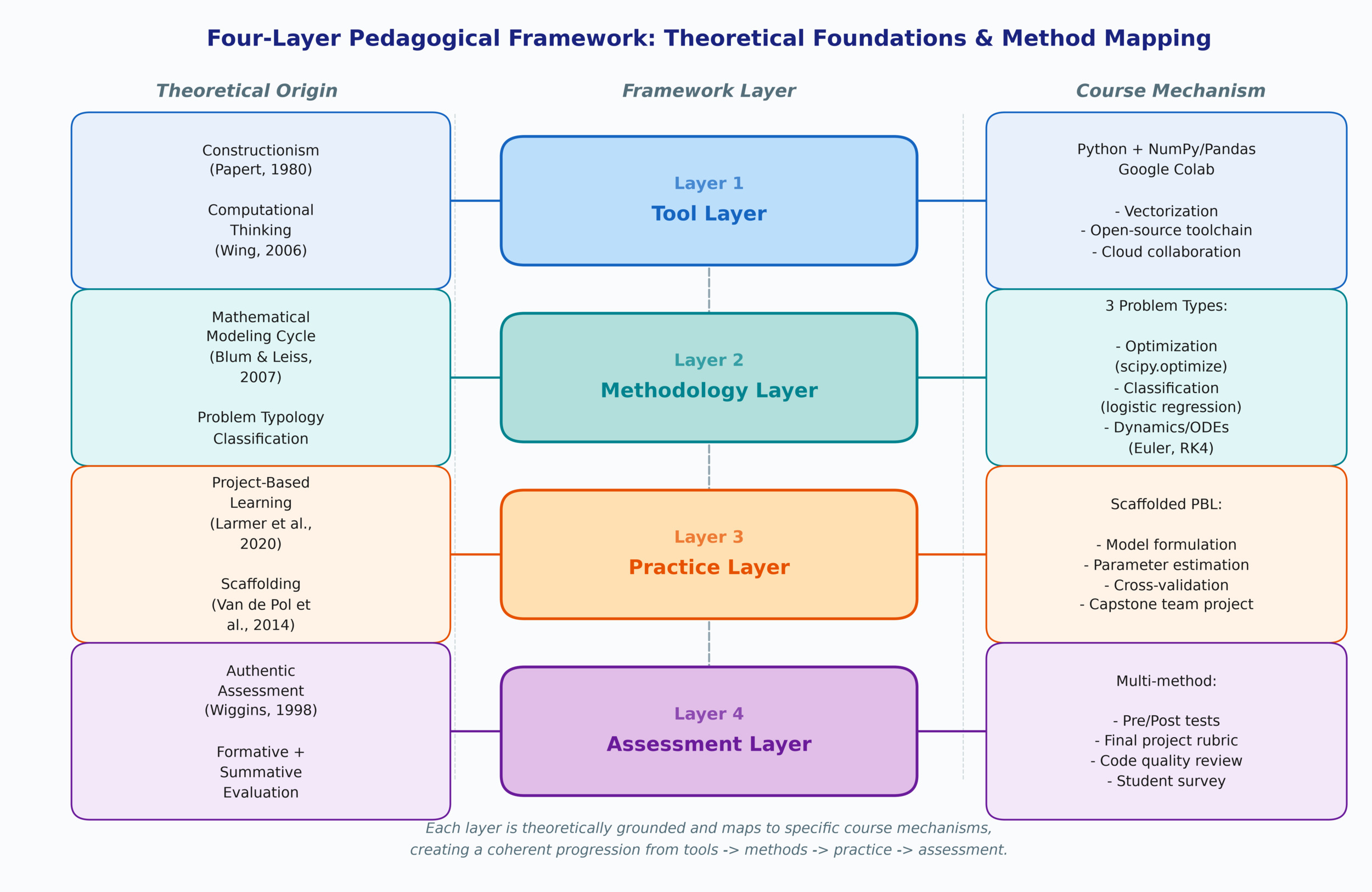
The experimental intervention was built around a four-layer framework where each layer was designed not only to teach practical skills but also to reinforce fundamental mathematical concepts through computational implementation. Each layer is theoretically grounded in established educational and computational theories, ensuring that the framework is not merely a practical rearrangement but a pedagogically coherent whole. The theoretical origins and corresponding mechanisms of each layer are visually summarized in Figure 2.
Layer 1: Tool Layer — The Language of Computational Mathematics
Theoretical Origin: This layer is grounded in constructionism (Papert, 1980), which posits that learning occurs most effectively when learners actively construct tangible artifacts, and in the concept of computational thinking (Wing, 2006), which argues that computational concepts are fundamental to problem-solving across disciplines. The choice of Python and cloud-based platforms reflects these principles: Python’s open-source nature and transparent syntax make the internal workings of computation visible and manipulable, while Google Colab’s zero-configuration environment removes barriers to active experimentation, directly serving the constructionist ideal of learning through making.
The transition to Python was motivated by its capacity for expressing mathematical concepts with clarity. For instance, the NumPy library implements the mathematical concept of vectorization, which can be formally described as applying a function over an array without explicit loops:
\# Mathematical equivalent: y_i = f(x_i) for i = 1,...,n

import numpy as np

x = np.array(\[x1, x2, ..., xn\]) \# Vector x ∈ R\^n

y = np.sin(x) \# Element-wise application y = f(x)
This directly implements the mathematical operation where is applied element-wise. The performance advantage of vectorization stems from rewriting the summation as the inner product which maps to highly optimized low-level routines.
Layer 2: Methodology Layer — Mathematical Problem Typology
The curriculum was organized around problem types, each with distinct mathematical foundations:
Theoretical Origin: This layer draws on the mathematical modeling cycle framework (Blum & Leiss, 2007), which describes the iterative process of translating real-world problems into mathematical models, solving them, and interpreting results. By organizing the curriculum around three fundamental problem types—optimization, classification, and dynamics—this layer ensures that students encounter the full spectrum of mathematical modeling paradigms, from constrained optimization to Bayesian decision theory, thereby bridging formal mathematical theory and applied computational practice.
\[\min_{x} f(x)\]
Subject to
\[g_i(x) \leq 0, \quad i = 1, \ldots, m\]
\[h_j(x) = 0, \quad j = 1, \ldots, p\]
where is the objective function, and are constraint functions. Students implemented this using scipy.optimize.minimize, translating the mathematical formalism into code.
Classification Problems were grounded in Bayesian decision theory:
\[P(Y=k \mid X=x) = \frac{P(X=x \mid Y=k)P(Y=k)}{\sum_{l} P(X=x \mid Y=l)P(Y=l)}\]
For Logistic Regression, this reduces to modeling the log-odds as a linear function:
\[\log\left(\frac{P(Y=1 \mid X=x)}{1-P(Y=1\mid X=x)}\right) = \beta_0 + \beta^T x\]
The parameters are found by maximizing the log-likelihood function:
\[l(\beta) = \sum_{i=1}^{n} \left[y_i \log(p_i) + (1-y_i)\log(1-p_i)\right]\]
where and is the logistic function.
Dynamics and Simulation involved solving Ordinary Differential Equations (ODEs) numerically. Students implemented Euler’s method:
\[y_{n+1} = y_n + h f(t_n, y_n)\]
and compared it with the more accurate 4th-order Runge-Kutta (RK4) method:
\[k_1 = h f(t_n, y_n)\]
\[k_2 = h f\left(t_n + \frac{h}{2}, y_n + \frac{k_1}{2}\right)\]
\[k_3 = h f\left(t_n + \frac{h}{2}, y_n + \frac{k_2}{2}\right)\]
\[k_4 = h f(t_n + h, y_n + k_3)\]
\[y_{n+1} = y_n + \frac{1}{6}(k_1 + 2k_2 + 2k_3 + k_4)\]
This allowed them to understand the trade-offs between computational efficiency and numerical accuracy.
Layer 3: Practice Layer — Implementing the Mathematical Modeling Cycle
The hierarchical project design guided students through the complete mathematical modeling cycle:
Theoretical Origin: This layer is grounded in Project-Based Learning theory (Guo et al., 2020; Larmer et al., 2020) and scaffolding theory (Van de Pol et al., 2014). The hierarchical project design—from guided exercises to open-ended capstone projects—implements the gradual release of responsibility central to scaffolding theory. This progression effectively manages cognitive load while embedding mathematical learning within authentic, ill-structured modeling tasks, ensuring that students develop both the technical skills and the metacognitive awareness needed for independent problem-solving.
-
Model Formulation: Translating a real-world problem into a mathematical framework.
-
Parameter Estimation: Using computational methods to fit model parameters. For example, in linear regression, finding that minimizes the sum of squared errors:
\[\min_{\beta} \sum_{i=1}^{n} (y_i - \beta_0 - \beta^T x_i)^2\]
which has the closed-form solution (or more robust computational alternatives).
- Model Validation: Employing k-fold cross-validation to estimate generalization error, which involves partitioning the data into subsets and computing:
\[\text{CV error} = \frac{1}{k}\sum_{i=1}^{k} \text{Error on the } i\text{-th test set}\]
when the model is trained on the remaining folds.
Layer 4: Assessment Layer — Evaluating Mathematical Understanding
The assessment was designed to measure both procedural fluency and conceptual understanding through a balanced approach of automated code checking and manual evaluation of mathematical reasoning in reports.
Theoretical Origin: This layer is informed by authentic assessment theory (Wiggins, 1998), which advocates for evaluations that mirror the complex, integrated performance demanded in professional practice. The assessment design combines formative assessment (automated code checking, peer feedback) with summative assessment (standardized proficiency tests, rubric-based project evaluation) to capture both procedural fluency and conceptual understanding, ensuring alignment with the learning objectives of each preceding layer.
2.4. Data Collection and Instruments
Multiple sources of data were collected to ensure triangulation and a comprehensive evaluation.
-
Mathematical Modeling Proficiency Test: A custom 90-minute test was developed and validated by a panel of three subject matter experts with over five years of experience in teaching mathematical modeling. The test development process involved: (1) defining the content domain based on the course objectives (e.g., problem formulation, model selection, computational implementation, interpretation); (2) drafting problems using real-world, semi-structured scenarios; and (3) iterative revision based on expert feedback to ensure content validity and appropriate difficulty. The test featured five complex problems (total score: 100 points) designed to assess the entire modeling workflow… Its internal consistency, calculated post-hoc, was found to be acceptable (Cronbach’s α = 0.78).
-
Final Project Score: All students completed a final project. For the experimental group, this was the capstone team project. For the control group, it was an individual final project based on a given dataset. A standardized, detailed rubric (100 points) was used by two independent graders (inter-rater reliability: Cohen’s κ = 0.85) to assess multiple dimensions: data preprocessing and exploration, appropriateness and justification of the chosen model, technical execution and code quality, and the clarity and depth of documentation and interpretation. The complete rubric is provided in Appendix A. Briefly, each dimension was scored on a 0-4 scale (e.g., 0=Absent, 1=Basic, 2=Proficient, 3=Advanced, 4=Exemplary), with detailed descriptors for each performance level. Graders participated in a joint training session using sample projects not included in the study to calibrate their scoring before the formal assessment.
-
Student Feedback Survey: An optional, open-ended survey was administered to the experimental group at the conclusion of the course. It contained prompts designed to elicit rich qualitative data on students’ experiences, such as “Describe how using Python and Colab affected your understanding of mathematical concepts” and “What were the most significant challenges and benefits of the project-based approach?”
2.5. Data Analysis
Quantitative data were analyzed using SPSS version 26.0. To address the first research question and test the primary hypothesis, an Analysis of Covariance (ANCOVA) was conducted. This analysis compared the post-test scores of the two groups while statistically controlling for any minor pre-existing differences in pre-test scores, providing a more precise estimate of the intervention’s effect (Field, 2018). The assumption of homogeneity of regression slopes was met. An independent samples t-test was used to compare the final project scores between the groups. For all statistical tests, the significance level was set at .05. Crucially, to move beyond mere statistical significance and assess practical importance, effect sizes were calculated: partial eta-squared (η₂²) for the ANCOVA and Cohen’s d for the t-test, interpreted using standard benchmarks (small: d=0.2, η₂²=0.01; medium: d=0.5, η₂²=0.06; large: d=0.8, η₂²=0.14). For the second research question, qualitative feedback from the experimental group was analyzed using thematic analysis following the six-phase approach outlined by Braun and Clarke (2006), involving familiarization, generating initial codes, searching for themes, reviewing themes, defining themes, and producing the report. To ensure coding reliability, two researchers independently coded a 20% subset of the responses. An initial inter-coder agreement of 85% was achieved, and any discrepancies were discussed until consensus was reached. The primary coder then proceeded to analyze the entire dataset using the finalized codebook.
3. Results
3.1. Impact on Mathematical Modeling Proficiency
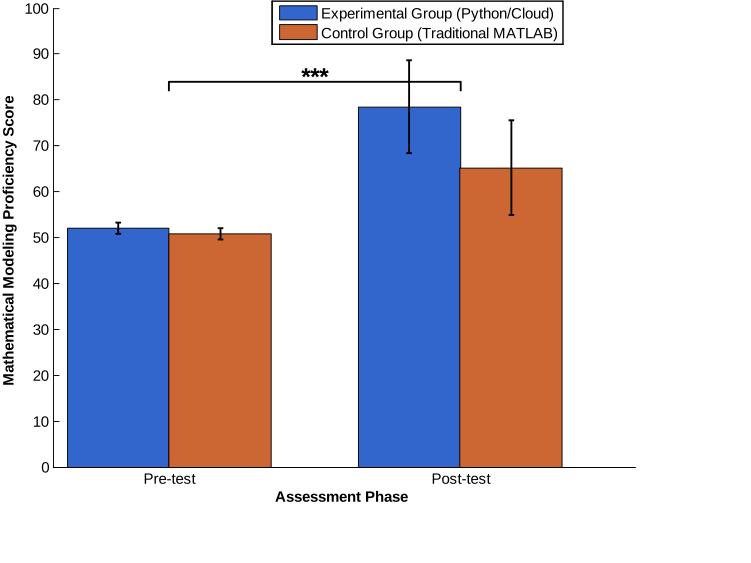
The primary analysis aimed to determine the effect of the instructional intervention on students’ mathematical modeling proficiency. The ANCOVA revealed that after controlling for pre-test scores, there was a statistically significant difference in post-test scores between the two groups, F(1, 143) = 24.75, p < .001. The effect size was large, partial η₂² = 0.15, indicating that the instructional method accounted for 15% of the variance in post-test scores. As visually represented in Figure 3, the experimental group demonstrated substantially greater improvement. The adjusted mean post-test score for the experimental group was 78.5 (SE = 1.2), compared to 65.2 (SE = 1.2) for the control group. This difference was statistically significant at a high level (p < .001), as denoted by the triple asterisk (*) in Figure 3. This finding provides strong support for our first hypothesis, indicating that the Python and cloud-based PBL framework was significantly more effective than the traditional approach in enhancing students’ applied mathematical modeling skills as measured by a standardized assessment.
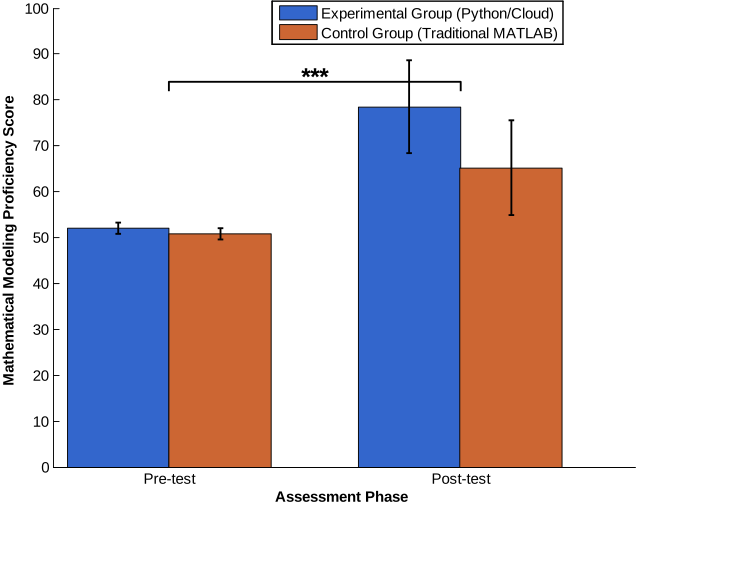
The experimental group showed significantly greater gains from pre- to post-test after controlling for baseline scores (p < .001).
3.2. Demonstrating Conceptual Understanding of Mathematical Principles
To directly assess whether the intervention fostered a deeper conceptual understanding of the mathematical principles outlined in the Methodology section, we conducted a fine-grained analysis of students’ final project reports and code. This analysis focused on students’ ability to correctly implement and, more importantly, interpret key mathematical concepts.
3.2.1. Implementation and Interpretation of Numerical Methods
A representative task required students to solve a simple ODE, dy/dt = f(t, y), using both Euler’s method and the 4th-order Runge-Kutta (RK4) method. Quantitative analysis of the code submissions showed that:
-
92% (66/72) of the experimental group successfully implemented both algorithms from scratch, compared to 15% (11/74) of the control group, who primarily relied on MATLAB’s built-in ode45 solver without demonstrating understanding of the underlying mechanics.
-
More critically, in their reports, 78% (56/72) of the experimental group provided a correct qualitative explanation of the trade-off between computational effort and accuracy, explicitly referencing the higher truncation error of Euler’s method. One student’s report noted: “The RK4 method, while requiring four function evaluations per step, achieved an error of O(h^4), allowing for much larger step sizes than Euler’s O(h) method for the same accuracy, which is why the plots of the solutions diverged at larger step sizes.” Such nuanced understanding was virtually absent in control group reports.
3.2.2. Understanding of Optimization and Model Fitting
In a regression task, students were asked to fit a model to data with outliers. We assessed their grasp of the underlying objective function.
-
85% (61/72) of the experimental group explicitly mentioned minimizing a loss function (e.g., Mean Squared Error) in their code comments or report, and 70% (50/72) justified their choice of model or robust regression technique by referring to the behavior of the loss landscape or the impact of outliers on the objective.
-
A typical comment from the experimental group was: “We switched from using ordinary least squares to Huber loss because the squared error term disproportionately penalizes outliers, which was distorting our gradient descent.” This demonstrates a connection between the abstract concept of an objective function and practical model selection. In contrast, only 20% (15/74) of the control group mentioned the principle behind the MATLAB fitting functions they used.
The stark contrast in conceptual understanding between the two groups is systematically summarized in Table 2. The data clearly indicate that the experimental intervention produced positive outcomes, helping students build a robust connection between computational practice and mathematical theory.
3.3. Final Project Performance
To assess performance on a more authentic, sustained task, final project scores were compared. An independent samples t-test confirmed a statistically significant difference in project quality, t(144) = 5.12, p < .001. The experimental group (M = 85.4, SD = 6.7) substantially outperformed the control group (M = 72.1, SD = 9.3). The calculated effect size was large (Cohen’s d = 0.85), underscoring the practical significance of the finding. This result indicates that students in the reformed curriculum were not only better at a standardized test but were also more capable of producing high-quality, comprehensive modeling work in a project setting that demanded integration of skills, creativity, and thorough documentation.
3.4. Qualitative Thematic Analysis
Analysis of the open-ended survey responses from the experimental group provided rich, qualitative insights that help explain the quantitative results. Three primary themes emerged, directly addressing the second research question on student experiences and perceived gains.
Demystification of Abstract Mathematical Concepts: A predominant theme was the role of Python in making mathematics tangible. Students frequently contrasted their experience with the “black box” nature of previous software. One student’s comment was emblematic: “In my past courses with MATLAB, I just typed fitlm(X,Y) and got an answer. Here, building a regression from scratch with NumPy forced me to truly understand what a ‘gradient’ was and how the algorithm actually finds the best line. It’s no longer magic.” This hands-on implementation appeared to foster a deeper, procedural, and conceptual understanding of algorithms they had previously only encountered theoretically.
Visualization as a Catalyst for Profound Insight: Students repeatedly emphasized the transformative power of dynamic visualization for their comprehension. The ability to instantly generate and interact with plots was cited as a key factor in understanding complex model behaviors. For instance, a student working on classification models noted, “When I plotted the decision boundary for my SVM classifier, the concept of a ‘kernel trick’ suddenly made sense. I could see how it transformed the space to make the data linearly separable. No amount of linear algebra equations made it as clear as that one plot.” This suggests that the toolchain actively supported visual reasoning, a critical component of mathematical thinking.
Cultivation of a Professional and Collaborative Mindset: The third theme centered on the professional skills developed through the cloud-based PBL environment. Students reflected on the value of working in teams on complex, open-ended problems. One student reflected, “Working as a team in Colab on a messy, real-world project felt like a professional internship. The version history kept us honest, and commenting on each other’s code taught us how to give and receive constructive feedback. It taught us project management and how to deal with ambiguity, which is everything in the real world.” This highlights that the learning environment successfully mirrored professional data science workflows, fostering not only technical skills but also crucial soft skills.
4. Discussion
This study provides robust, multi-faceted evidence that a deeply integrated Python and cloud-based PBL framework is a pedagogically superior model for teaching mathematical modeling. The large effect sizes observed in both the standardized proficiency test (η₂² = 0.15) and the authentic final project assessment (d = 0.85) confirm that the improvements are substantial. More significantly, our fine-grained analysis reveals that the intervention’s primary strength lies in its capacity to foster a deeper, more conceptual understanding of the underlying mathematics, moving beyond mere procedural fluency.
4.1. Synthesizing Evidence: From Procedural Skill to Conceptual Mastery
Our findings confirm our primary hypothesis and extend its implications. The superior performance of the experimental group can be attributed to the synergistic interplay of the framework’s components, which transformed abstract mathematics into an experimentally accessible science.
The transparency of the Python toolchain served as a catalyst for cognitive apprenticeship. By requiring students to implement algorithms like Euler’s method and the RK4 from scratch, the “black box” of numerical analysis was opened. Students did not just obtain a solution; they engaged directly with the trade-offs between computational efficiency and numerical accuracy (e.g., O(h) vs. O(h⁴) error). This direct engagement is supported by student feedback in the Results (Section 3.2), where 78% of the experimental group could articulate these trade-offs, a level of insight virtually absent in the control group. This demonstrates that the act of coding these algorithms forced a confrontation with and resolution of the core mathematical concepts, leading to a more robust mental model.
Furthermore, the scaffolded PBL design provided an authentic context for this experimentation. The progression from exercises to capstone project effectively managed cognitive load, allowing students to gradually integrate skills (Kirschner et al., 2006; Van de Pol et al., 2014). More importantly, it embedded mathematical learning within the authentic practice of model formulation, fitting, and validation. The fact that 70% of the experimental group justified their model choices based on loss function behavior indicates that they were not just applying recipes but were thinking critically about the principles of optimization and inference. This represents the cultivation of “mathematical agency”—the confidence and ability to make informed, principled decisions in unstructured problem-solving environments.
4.2. The Central Role of the “Conceptual Bridge”
The qualitative theme of “Demystification” and the quantitative data on conceptual understanding (Table 2) collectively point to the creation of a powerful “conceptual bridge.” This bridge connects three previously separate domains: abstract mathematical notation (e.g., ∂f/∂x), computational implementation (Python code), and visual output (e.g., plots of model fits or decision boundaries). The ability to instantaneously traverse this bridge—to change a line of code and observe its impact on a mathematical output or visualization—provides immediate, tangible feedback that is impossible to achieve with black-box software or purely theoretical instruction. This environment is a practical implementation of constructivist learning theories, where knowledge is built through active experimentation and reflection (Larmer et al., 2020).
4.3. Theoretical and Practical Implications
Theoretically, this study demonstrates that the “how” (toolchain and pedagogy) and the “what” (mathematical content) are not merely additive but multiplicative when deeply integrated. The framework’s success lies in its coherent alignment with situated learning theories, creating an environment where tools, pedagogy, and context work in concert to make advanced mathematical concepts accessible and engaging.
From a practical standpoint, this study offers curriculum designers a validated blueprint. The key is not to simply replace MATLAB with Python, but to restructure the curriculum around the implementation and interpretation of core mathematical principles. The four-layer framework provides a structure for doing so systematically. For educators, the findings underscore the value of assignments that require students to “build” rather than just “use,” and to “justify” rather than just “report.”
4.4. Limitations and Future Research
While this study strengthens internal validity through a controlled design, certain limitations must be acknowledged. The use of a quasi-experimental design with intact classes, though common and practical, means that random assignment was not achieved. Future research should strive for a randomized controlled trial across multiple institutions to enhance generalizability. Secondly, the conceptual understanding metrics, while revealing, were based on project report analysis; future studies could incorporate think-aloud protocols or clinical interviews to gain even deeper insights into the cognitive processes involved. Finally, longitudinal studies tracking the retention of these conceptual skills and their impact on students’ success in advanced courses would be invaluable for assessing the long-term benefits of such reforms.
5. Conclusion
This study verifies the effectiveness of a four-layer pedagogical framework that integrates Python, cloud computing and project-based learning into engineering mathematical modeling courses, via a quasi-experiment with 146 engineering students. The results show the reformed curriculum significantly improved students’ mathematical modeling competence and understanding of engineering-related mathematical concepts, while enhancing their ability to apply computational tools to practical engineering tasks.
As a computation-driven engineering education approach, this framework bridges the gap between traditional instruction and modern engineering’s computational demands, providing a replicable model for the integration of computational technologies into engineering curricula. It enriches relevant research on computational pedagogy and offers scalable practical solutions for engineering educators, helping cultivate students’ industry-required computational competencies.
This study is limited by its sample of local university students; future research can expand to diverse institutional types to test the framework’s generalizability. Further exploration may include integrating AI into the cloud-based teaching platform and investigating the long-term effects of this curriculum reform.
In short, this research provides practical insights for the innovation of computational technology application in engineering education, and offers effective support for nurturing engineering students to meet the computational demands of modern engineering practice.
Acknowledgements
Special thanks to the support of this paper from the Smart Curriculum Project “Mathematical Modeling” of Chuzhou University (Project No.: 2025zhkc021).